Chirashizushi

The four heavenly creatures in Japanese mythology are: Seiryu the blue-green dragon, Suzaku the vermilion bird, Byakko the white tiger and Genbu the black turtle.  They govern over the four points of the compass, appear as major constellations in the night sky, embody four of the five classical elements and are representatives of the four seasons.  These godly animals are honoured annually with festivals held for each of them throughout Japan, but their presence can also be felt watching over you more subtly during other times of the year, if you know where to look.

One of the most well known events of Spring is Hinamatsuri, or Doll’s day- red fabric-draped platforms appear in houses, shrines and businesses, and atop these pedestals sit ornamental dolls in the form of the Emperor, Empress, ministers, musicians and other courtly attendants.  People celebrate, pray for the health and happiness of girls in their family, drink shirozake, and most popularly, eat bowls of seasoned rice strewn with a confetti of celebratory toppings.  Literally meaning ‘scattered sushi’, chirashizushi -whilst not only being delicious- pays tribute to the four heavenly creatures by means of their respective colours; blue, red, white and black, all of which are present in the toppings: crisp, tangy vinegared renkon for Byakko; savoury, umami packed shreds of nori and mushrooms for Genbu; crunchy, fresh pieces of mangetout for Seiryu; and finally the saline, bursting bubbles of ikura for Suzaku.  Like the dolls of the festival, these toppings perch on a carpet of shredded sweetened omelette, laid over a platform of seasoned su meshi rice, creating a meal perfectly balanced in textures and flavours.

By far one of the simplest sushi dishes to make in the home, chirashizushi doesn’t require any of the precision slicing or delicate wrapping of seaweed commonly associated with the cuisine, yet it makes a fantastic, vibrant dish to bring to the table for celebrations of all kinds.  It also works incredibly well packed as a bento lunch for those special occasions when you won’t be at home, and is perfect for taking to a tranquil spot in the countryside for a leaf or blossom viewing party.

chirashizushi
Chirashizushi- glistening pearls of salmon roe scattered over sushi rice.

Continue reading “Chirashizushi”

Tonkatsu

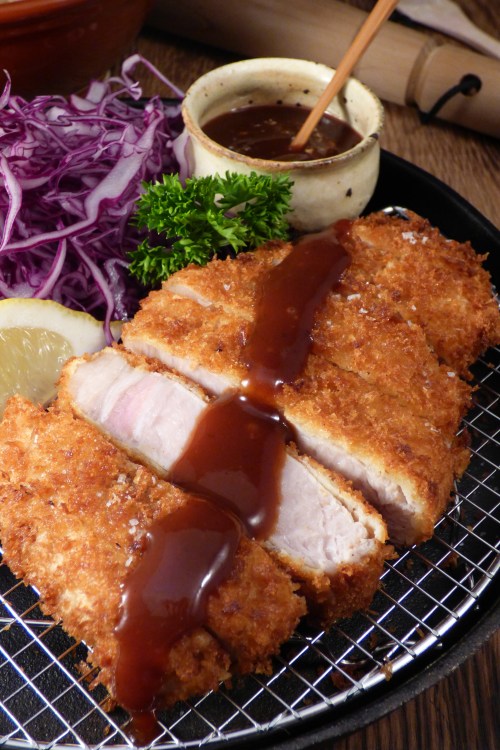
Of all the little rituals and practices involved in Japanese dining, my favourite is associated with preparing the sauce that accompanies crispy, deep fried pork at nearly all good tonkatsu restaurants.  The sound of a wooden surikogi grinding against the coarse, ribbed ceramic suribachi evokes images of craftsmen and traditions long lost to history; the nutty aroma of the sesame seeds pulverised between stick and bowl rise to meet your nose and do just as much to ready your appetite as the smell of the meat itself.  You dampen the crumbly powdered seeds with a ladle or two of tangy sōsu from a dark glazed pot, swirl it briefly with a stroke of your surikogi, then plunge a scalding hot nugget of pork into the marbled sauce on its way towards your mouth.  The simple but delicate act of adjusting the flavour of the sauce you’re about to eat creates an emotional connection to the food that makes you far more appreciative of it; it no longer feels like a quick bite to eat, it’s a feast that you’ve helped to make in some small way.  Each mouthful feels more satisfying and precious than it would have if you’d been served the seeds ready ground- and the flavour, far greater still.

Of course, this act of grinding your own seeds isn’t the only element that makes a tonkatsu meal so enticing; the incredibly hot, crisply crumbed, juicy fried pork steaks; the mountain of crunchy, cooling shredded cabbage (which normally comes with unlimited refills); the sticky, perfectly cooked blend of rice and barley mounded up in your bowl; and the ability to choose between the fattier more flavourful rosu and the tender and cleaner tasting hire cuts of pork all help make it one of our favourite meals to eat in Japan.

You can follow the same technique described below with a flattened out chicken breast to make torikatsu, a variation of tonkatsu which has become even more popular in the UK than the original, and frequently served with karē sauce.


tonkatsu
Tonkatsu- Juicy fried pork perfection.

Continue reading “Tonkatsu”

Onsen Tamago

Once places of legend and mystery- boiling sulphurous waters forced from deep within the earth, gouts of fiercesome steam and perhaps even home to ghosts and monsters- the onsen or spa towns that are dotted along Japan’s mountain ranges are now prime destinations for people to bathe and absorb the health giving properties of the mineral rich waters.  Tourists flock to towns such as Beppu in Kyushu to take in the eight different ‘Hells’, buy concentrated mineral salts to infuse their own baths at home and to sample local foods cooked in the steam that issues from the hillside.  These geothermally cooked foods are not just a recent invention for tourists however, locals have been utilising the naturally stable and constant temperature of the springs to prepare their food for centuries, the most popular use being for soft poached eggs, or onsen tamago.  After dropping a basket of eggs into the pool of a hot spring, they could be left unattended for an hour or two while the owner went about their other duties (or simply had a relaxing bath) before returning to collect their cooked eggs- rich, soft, custardy yolks, suspended within the silkiest of egg whites, the type of slow cooked eggs that modern restaurant reviewers rave about.

These most delicate of eggs can be made just as well at home and with no need for a volcanic hot spring, slow cooking them for three quarters of an hour at a low temperature is all that’s needed to coax the eggs to lightly set perfection.  Unlike boiled eggs which are forced into springy submission by the fierce heat of the water, onsen tamago are gently persuaded to gel into a mass that can barely hold itself together, collapsing lazily at the slightest touch of a chopstick into a creamy unctuous puddle.  They’re a staple part of a Japanese breakfast, served on top of steaming hot rice or plunged in a pool of broth, but they also make an incredible topping for a bowl of ramen, cracked open over a plate of spicy karē-raisu or dipped into batter and fried as one of the most delectable tempura imaginable.


onsen-tamago
Onsen Tamago- slow seduction and a long bath make the silkiest eggs.


Continue reading “Onsen Tamago”

Hokkaido Butter Ramen

When one thinks of ramen, deep steaming bowls of unctuous porky broth often spring to mind, accompanied by slices of meltingly fatty meat, perhaps a haphazard pile of spicy spring onions and some savoury marinated menma.  By no means is this the only way the Japanese crave their soup noodle fix though, with areas of the country creating their own specialities reflecting their own tastes and regional produce.  One version of the dish we were recently introduced to and have reproduced here is the poetically named Kitano Megumi Ramen, or the Blessing of the North Ramen; a creamy, soothing concoction that rejoices in using everything good from the most northerly island- Hokkaido.

Thanks to its cooler climate and the massive expanses of pasture land that cover Hokkaido- the least developed of the main islands- it is able to support a thriving dairy industry.  Smooth milk and rich, creamy butter from the island command a high price because of their superior quality- they proudly display their heritage and nearly always have the iconic outline of Hokkaido prominent on their packaging.  Similarly, prime examples of sweetcorn grow in abundance on the rich, volcanic soil and the kernels are often found bobbing around playfully in the salty, miso based ramen broths favoured in Sapporo, surprising your palate with a pop of freshness.  Particularly juicy cooked hams crafted from Sangen pigs complete this cornucopia of produce from the rugged north, creating a uniquely Hokkaidoan interpretation of the classic ramen.

To compliment the savoury, milky soup we’ve created a dashi flavoured compound butter to crown the ramen, but don’t feel limited to using it on just this dish- a pat or two of the smoky, seaweed infusion makes a fantastic oozy topping for a rib-eye steak or pork chop, and when tossed into steamed greens it lifts a relatively basic vegetable and turns it into something very special.


butter-ramen
Hokkaido Butter Ramen- creamy blessings from the North


Continue reading “Hokkaido Butter Ramen”

Nikujaga

Nikujaga, which translates literally as ‘meat and potatoes’, is pure unadulterated comfort food; to many Japanese people it is a taste of home and the memory of mother’s cooking. This sweet, incredibly warming, wintery dish has an easy-to-trace heritage going back to the beef stew served by the British Royal Navy in the late 1800s, and one Japanese cadet who was sent to England to further his naval studies.  Tōgō Heihachirō, who had achieved the rank of lieutenant before returning to Japan, had developed a fondness for the cuisine of his alma mater; describing the dish to the chefs of the Imperial Navy, he had them recreate its flavours using local ingredients and according to the story, nikujaga was born.

The key components of a classic British beef stew are still present- potatoes, carrots, onions and of course beef, although the latter being in a much smaller quantity than you would expect to find in the traditional version.  The similarities end there though- the umami-rich cooking liquor being made up of the staple Japanese ingredients of soy sauce, sake, mirin and dashi fish stock and the addition of chewy, glass-like shirataki noodles to complete the dish.  Like the original, nikujaga is the perfect simple and nostalgic meal to warm you up on a cold, wet winter’s day whichever side of the world you’re on.

nikujaga
Nikujaga- Japanese Navy style beef and potato stew


Continue reading “Nikujaga”

Tantanmen

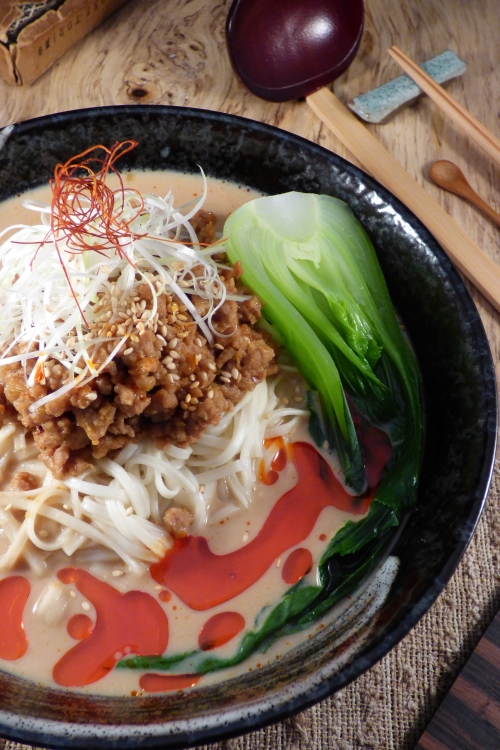
Our first encounter with tantanmen- the Japanese version of the chilli laced, sesame sauced Sichuan noodle dish dandanmian- came in a cramped ramenya down a nondescript backstreet in the Tokyo district of Shibuya.  Sat at a dimly lit wooden counter where the thick varnish had been worn away by decades of jostling elbows from hungry diners, the chef placed before us two deep bowls of noodles sunken beneath blush ivory coloured broth, swirled with a bright red slick of rāyu and a scattering of fried pork.  After the initial shock of the vibrant colours against the dark bowls we were struck by the rich, earthy sesame aroma followed by the sweet smell of long-simmered chicken stock.  One messy, clumsily slurped mouthful was all it took for us to fall head over heels for this red-faced cousin of the classic pork ramen; the tingly chilli-kissed lips only helped our feelings grow stronger.

Little known outside of Japan, tantanmen has become a staple in many noodle restaurants and as a quick to prepare dinner for rushed parents to whip up for their ever-hungry children after school.  Much like most other styles of ramen, a powerfully flavoured broth assisted by a couple of well cast supporting characters is the key to a memorable meal.  Homemade chicken stock is enhanced with creamy, nutty sesame paste to give an incredibly rounded flavour, then poured over deliciously toothsome chukamen noodles before being topped with intense, salty pork mince seasoned with miso and sake.  The whole dish is then drenched (or perhaps merely drizzled, depending on your feelings towards spiciness) in chilli infused rāyu oil to not only increase the heat levels, but also to boost the savoury flavours and add the fat needed to smooth out the consistency and texture of your noodles.

Incidentally, the miso seasoned pork mince is a fantastic meaty component to a bento, or it works incredibly well alongside some scrambled eggs as a topping for a bowl of rice to make an easy version of the classic soboro-don.

tantanmen
Tantanmen- as creamy and nutty as it is spicy and intense.


Continue reading “Tantanmen”

Hiyayakko Tofu

As the sweltering summer days drift slowly into mild, contemplative Autumn, nature’s hues turn to yellows and reds, and we long for cooling, refreshing food to take our minds off what’s left of the oppressive heat; luckily our gardens present us with exactly what we need- a bountiful crop of round, juicy tomatoes.  Cooking with tomatoes isn’t exactly commonplace in Japan; they are however often enjoyed on their own, added to colourful salads or used as a bright topping for a cool creamy block of tofu along with something a little neba neba.

Neba neba is an onomatopoeic word used to describe foods with a sticky, slimy or stringy texture- qualities not normally desired in most Western cuisine, but looked upon as being incredibly healthy and delicious in Japan.  The spectrum of neba neba ingredients range from those suited only to the most dedicated gourmand- pungent fermented soybean natto, raw egg whites, and tororo grated mountain yam- to the entry level mozuku seaweed, nameko gelatinous mushrooms and the almost universally accepted okra.  While many cultures have fought against okra’s desire to impart a gluey consistency to dishes by soaking out the juices or refusing to cut the vegetable, Japanese chefs have embraced and even sought out ingenious ways to encourage this characteristic.

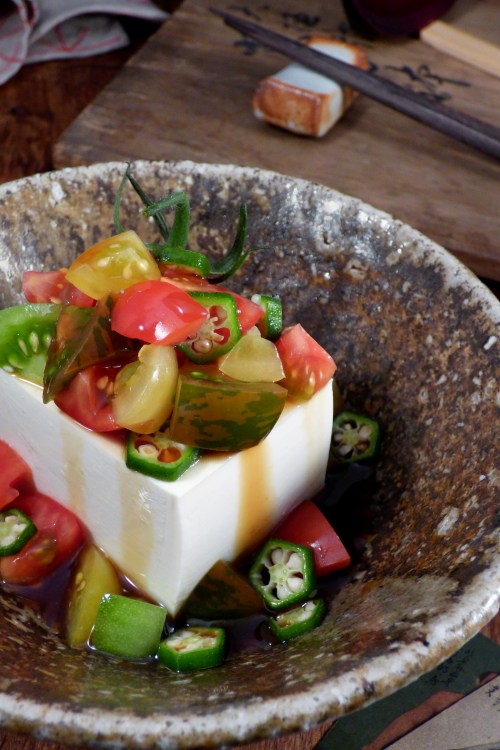
Our recipe for hiyayakko tofu is a great way to gingerly encounter neba neba food for the first time.  It combines both tomatoes and okra with a refreshingly sharp and citrussy ponzu dressing to give a dish that is both cool and creamy, but still packed with enough zingy, salty punch to liven things up a little and the slightest hint of the stringy texture that the Japanese so love.


hiyayakko-tofu
Hiyayakko Tofu- cooling, creamy tofu, sweet juicy tomatoes and a fruity dressing.


Continue reading “Hiyayakko Tofu”

Ikameshi

The fishing town of Mori on the eastern coast of the Oshima Peninsula is famous for three things; sweet farmed scallops, bountiful catches of Pacific herrings and an abundance of Japanese flying squid.  It was this easy-to-catch and incredibly popular squid that, with the ingenuity of a local shopkeeper, would help rice rations stretch twice as far during WWII and go on to become the regional dish of Hokkaido.  A bentō shop in Mori railway station came upon the idea of filling the cavity of the plentiful squid with the slowly dwindling rice supply before boiling it in a seasoned broth, the added bulk of the squid making the precious rice go that bit further.  As with so many other modern classic dishes, frugal cooks and wartime necessity had resulted in the creation of something delightful.

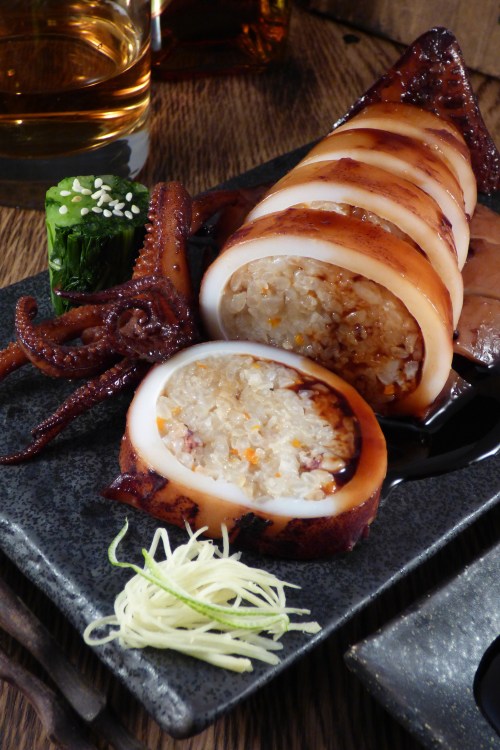
Plump, burnished squid stuffed to almost bursting point with sweet, pearlescent rice and glazed with a thick, sticky soy sauce have remained a station bentō favourite since they won their creator first prize in the annual Keio department store ekiben competition, which sought to find the best regional delicacies from around Japan.  Ikameshi makes an impressive but deceptively simple centrepiece for a meal, and is perhaps at its most hauntingly beautiful when served in a dimly lit, traditional izakaya accompanied by a handful of good friends and a glass or two of the local spirit.  We’ve shortened the preparation time of our ikameshi by steaming the rice before filling, which means that the squid cooks in about five minutes, preventing it from becoming tough.


ikameshi
Ikameshi- A parcel of rice wrapped in burnished squid.

Continue reading “Ikameshi”

Tako no Nanbanzuke

Whilst under Shogunate rule during the sixteenth and seventeenth centuries, trade and interaction with the outside world was tightly restricted, borders were sealed and Japan effectively became a closed country.  A closed country that is, except for the port of Nagasaki on the western coast of Kyūshū, a bustling hub for the importing and exporting of produce, people and ideas.  Much of the trade through Nagasaki was conducted with the Portuguese who were expanding their empire from Lisbon via the coasts of Africa, the Middle East and Goa.  These Nanban- Southern Barbarians- brought with them the Christian church, the technology to make firearms, foods like peppers, chillies and vinegar, and new cooking techniques such as deep frying in breadcrumbs and batter, all of which were assimilated quickly by the locals.  One of Portugal’s most popular methods of preserving fish for long journeys- escabeche, proved to be a huge success when tasted by the Japanese and has remained a favourite ever since.  Literally meaning ‘pickled in the southern barbarian style’, nanbanzuke normally refers to whole fried fish or fillets soused in a vinegary sauce with vegetables, but we’ve enjoyed it many times with octopus- another staple of the travelling Europeans.

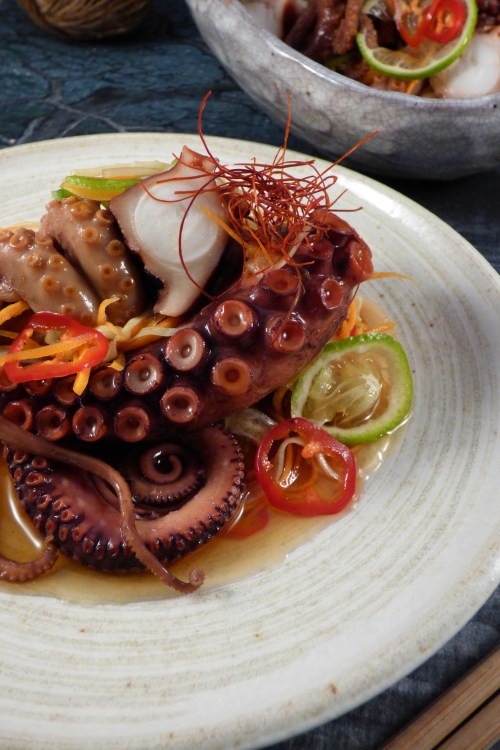
In our version of nanbanzuke we poach a whole octopus until tender, then marinade it with a selection of crunchy vegetables in a mixture of fish stock and rice vinegar with plenty of spicy red chilli and ginger to add some fieriness.  Served at room temperature, nanbanzuke makes a wonderful addition to a picnic lunch, or when chilled it’s the perfect dish to serve in the summer when all you want to eat is something cooling, light and refreshing.


tako no nanbanzuke
Tako no Nanbanzuke- pickled octopus, the barbarian way.


Continue reading “Tako no Nanbanzuke”

Tōgan Soboro Ankake

Summer fatigue or natsubate can be a big problem during the humid middle months of the year; people become lethargic, have trouble sleeping, lose their appetites and in the workplace, productivity hits an annual low.  The Japanese way to combat this starts with the copious amounts of air conditioning installed within practically every home and building, but the most effective treatment against overheating comes through the application of food.  You could follow in the habits of the kappa- a fart-loving mythical water dwelling creature, and enjoy a salty, marinated cucumber on a stick, perhaps sit down to a mound of shaved ice topped with mashed beans and fruity syrups or greedily devour a wedge of melon, but snacking can only get you so far through the day and eventually you’ll want to eat a real meal.  A dish of simmered and chilled tōgan- a close relative of both the cucumber and watermelon, can provide the relief needed to get you through the most oppressive of summer days.  Known across much of Asia as Winter Melon because it is one of the only fresh vegetables still available by that season, tōgan is recognised in both Ayurvedic and Yakuzen schools of medicine as being able to remove excess heat from the body and revive flagging energy.  After being cooked briefly in dashi and dressed with minced prawns and chicken, also known in folk remedies for its restorative qualities, this chilled tōgan makes a light but sustaining meal with a crisp bite and a soothingly cool sauce that makes even the hottest, stuffiest weather that little bit more manageable.


soboro ankake
Winter melon with shrimp and chicken ankake sauce- simple cooling food for hot summer days


Continue reading “Tōgan Soboro Ankake”