Kitsune Udon

We’ve been visiting noodle restaurants for almost as long as I can remember, and have passed over a basic sounding dish on the menu many times, dismissing its simplicity in favour of the more showy, topping laden bowls.  That is at least, until a couple of years ago whilst on a lunchtime visit to a market in Kyoto, we stopped by an udonya and tried the curiously named Kitsune Udon (fox noodles) for the first time and became instant converts.  A deep bowl of perfectly cooked, thick white udon, a slightly smokey, fish based soup, and a single piece of inari-age, simmered in a sweet soy and mirin liquor until the sponge-like tofu had absorbed a massive amount of flavour.  The clean soup paired with the rich, sweetness of the tofu was an incredibly soothing combination, and one that we’ve tried to eat as often as possible since our first taste.

Many people like to add narutomaki or kamoboko to their kitsune udon -and feel free to if you want, they’re both delicious additions- but we like to keep ours uncomplicated and the way we’ve always eaten it in Japan; just the noodles, the broth, a sweet slab of toothsome inari-age and a mound of spicy, fresh spring onions.  Perfect comfort food if you’re feeling a little under the weather and great fuel for foxes on a night-time prowl.

kitsune udon
Kitsune Udon- a soothing bowl of soup topped with seasoned abura-age, the favoured food of Japanese foxes.

Continue reading “Kitsune Udon”

Unadon to Samphire Gomaae

Hugely popular from its creation in the late Edo period, to modern times, Unadon- or Unagi Donburi to give the dish its full name- is one of the most common ways to eat freshwater eels in Japan.  An oversized lacquer bowl, a mound of perfectly cooked, pearly white rice, and a fillet of eel, glazed to a rich mahogany colour with a mixture of soy and mirin, caramelised and slightly charred.  The first time we ate unadon was early one Summer’s morning in Shibuya.  After a dawn visit to the Meiji shrine complex we needed a hearty breakfast to boost our flagging energy, knowing little Japanese at the time we stumbled across a restaurant that was open where we recognised the word for ‘eel’ and decided to give it a go.  It proved to be the ultimate reviver, the sugary, salty kabayaki glaze along with the big hit of protein and fat got us back on our feet in no time and it has gone on to become one of our favourite breakfast dishes.

Despite being traditionally eaten all over the UK, getting fresh eels nowadays is a little difficult, so over the years we’ve experimented with cooking different native fishes in the kabayaki style.  The closest match we’ve been able to find is the locally abundant garfish, long and silvery with a fine flesh and just a little fat, it even looks pretty similar to an eel and should be easy to get hold of in most fishmongers.  Whilst at our fishmongers we also saw some beautiful samphire for sale and knew that this vibrant, salty, shoreline succulent would make the perfect gomaae accompaniment to the unadon; while these are both classic breakfast dishes, they’re delicious for any meal of the day.

unadon
Unadon served with sesame dressed samphire.

Continue reading “Unadon to Samphire Gomaae”

Yaki Udon

Yaki Udon is a Fukuoka variation on one of Japan’s most beloved street foods- yakisoba, or fried noodles.  A colourful mixture of lightly wilted but still crunchy vegetables, a mound of chewy noodles and a scattering of meat or seafood, all fried together and coated in a sweet, fruity and slightly spicy sauce.  At festivals and in parks up and down Japan you’ll find yatai food carts serving yakisoba, the smell of the sōsu caramelizing on the huge iron hot-plates enticing you over and tempting you into having a bowlful.  Despite the name suggesting it should be made from buckwheat soba noodles, most of the country makes yakisoba with long, thin wheat noodles similar to ramen, while the people of Fukuoka have elevated the dish to an even more substantial place by making it with our personal favourite noodle, the thick and toothsome udon.

A seafood yaki udon was perhaps the first Japanese meal we ever ate, back in 2001, and it has remained a firm favourite since then.  Not many weeks pass by without us making a panful at least once, loaded with vegetables for a quick after-work evening meal.  It’s an almost infinitely flexible dish, add whatever vegetables or meat you like to it, just make sure that they’re bright, colourful and full of varied flavours and textures.

yakiudon
Fukuoka style yaki udon- more satisfying than the thinner, but equally delicious yakisoba.

Continue reading “Yaki Udon”

Kani Meshi

Crustaceans have always played a large part in the cuisine of Japan and one of our favourite uses of them is in kani meshi.  It belongs to a family of dishes known as takikomi gohan which translates roughly as ‘cooked with rice’.  In a similar way to a pilaf or kedgeree, takikomi dishes usually involve cooking rice in a seasoned broth to introduce extra layers of flavour along with the addition of vegetables or meat; in the case of kani meshi, this is the sweet juicy white flesh of a crab.

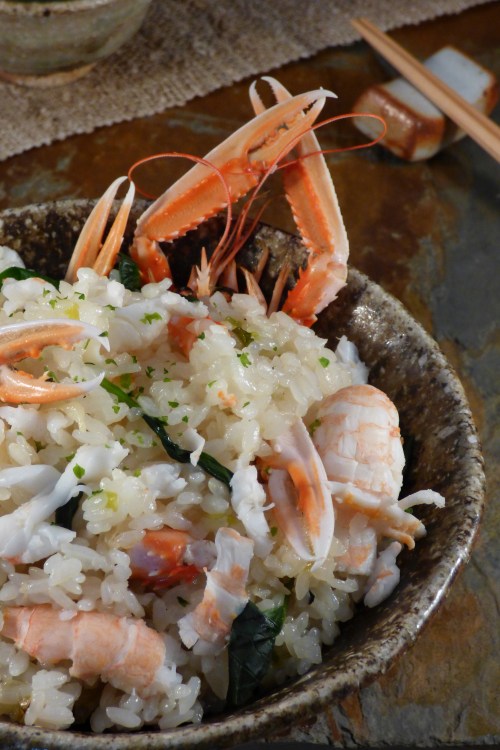
Whilst shopping for our kani meshi, we were distracted by some incredible looking Scottish langoustines, they were too perfect to resist- miniature, eight inch lobsters, fiercely armed and packed with a delicately perfumed flesh not dissimilar to prawns.  We decided on the spot that they would make a fantastic variation on the standard crab kani meshi, and to compliment their sweet briny flavour we’ve added some seaweed and dried bonito to create a subtly flavoured rice that reminds us of holidays by the coast, both here in the UK and in Japan.  Our kani meshi makes a great side dish in place of regular rice, and there’s a deliciously tactile pleasure in cracking the claws open and picking out the morsels of flesh from inside.

kanimeshi
Langoustine Kani Meshi.

Continue reading “Kani Meshi”

Karaage / Tatsuta-age

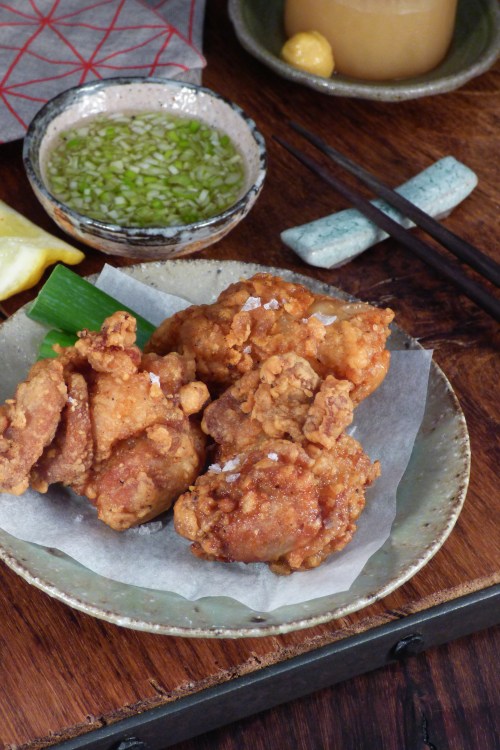
Fried chicken.  Two simple words that have the power to whet appetites across the globe and set imaginations spinning, whether you’re in Louisiana, Mali or Scotland, you know that when you order your local rendition of the dish you’ll be getting moist, juicy meat in a crisp coating packed full of flavour.  Karaage is the fried chicken of Japan- nearly always meat from the thigh of the bird, seasoned with soy sauce and ginger before being dusted in a light coating of potato starch and fried to crunchy perfection.  Unusually for Japanese cuisine, large amounts of garlic are included in the marinade for karaage, along with the addition of some sake this helps to offset the slightly gamey flavour that chickens had before post-war American birds were imported to become the mainstay of local farms.  The soy sauce used in marinating the chicken imparts a slightly reddish brown colour to the coating, which is said to resemble the reflection of maple leaves in the water of the river Tatsuta in Nara, and is how the dish received its second, more romantic name, Tatsuta-age.

We like to accompany our karaage with a fresh dipping sauce made from spring onions and shiro shoyu, or white soy sauce; brewed with more wheat than other soy sauces, it has a much milder flavour which makes it perfect for seasoning lighter meats such as chicken or seafood.

Whether you know them as karaage, Tatsuta-age or even as JFC, these two-bite-sized pieces of juicy chicken are a perfect way to start a meal or make a fantastic addition to a bento or lunch box.


karaage
Karaage- Japanese Fried Chicken

Continue reading “Karaage / Tatsuta-age”

Kakuni Manjū

Simultaneously being both the lightest, most delicate, cloud-like bun imaginable and the richest, sweetest, most succulent pork belly possible, kakuni manjū are perhaps the ultimate variation on a bacon sandwich and frankly, I can’t think of a better combination of meat and bread that I’ve ever eaten.

Like the sweet, soy braised pork that fills them, manjū– or hirata buns to give them their recently adopted American name- owe their heritage to Chinese steamed buns such as the snowy white stars of many a dim sum menu, char siu bao.  During the two hundred and twenty year period of isolation, Japan closed off its borders to the outside world, and the only way in or out was through Nagasaki, which quickly became what is now the country’s oldest Chinatown.  Workers and traders travelling through the port took with them their favourite home comforts which were quickly adopted by local restaurants and yatai (food carts) before spreading across the country.  Slow braised dongpo pork from Eastern China and pillowy mantou steamed bread from the North were two such dishes that arrived in this influx of unfamiliar cuisine, and were the culinary parents of this most delicious of sandwiches (perhaps with a little matchmaking courtesy of both Japan and China’s occupation of Taiwan and its now famous gua bao split steamed buns).

Breaking from tradition, we’ve added a few extras to our kakuni manjū- the creaminess of the mayonnaise and the crisp, refreshing bite of cucumber and shredded spring onions help to lift and round out the flavour of the bun.  Eat them on their own with a few drinks, or as is now common practice, as an accompaniment to a deep, meaty bowl of ramen for the ultimate pork filled meal.


kakuni manju
Kakuni Manju- a Nagasaki street food classic.

Continue reading “Kakuni Manjū”

Kamo Nanban Soba

The wonderfully rich, slightly gamey flesh of duck and the intense earthy, woodland flavour of mushrooms are one of the most natural and instinctive combinations in cookery.  It’s a pairing you might expect to see in Italy, Russia, Sweden or France; countries that used to be blanketed with dense forests and vast lakes, countries that have a deep folklore and long history of woodsmen, making their living from what nature provides.  All of these features are equally true of Japan, and unsurprisingly the Japanese made the same discovery early on, that marrying wild duck with foraged mushrooms was a union worth remembering.  The other classic Japanese accompaniment to duck are the buckwheat noodles known as soba.  Deliciously nutty in flavour and with a slightly toothsome texture, soba are one of the oldest known types of noodle in Japanese cuisine, dating back over 2500 years to the Jōmon period and even further in Chinese cookery where they probably originated.

We’ve combined all three of these ingredients in a classic Kamo Nanban Soba- a dish that smells and tastes like a stroll through an ancient forest; with rich, life giving soil and a wealth of fungus sprouting from the crumbling trunks of fallen trees.  It wouldn’t be a kamo nanban without some sweet, charred spring onions, and to lift the earthy flavours slightly we’ve added a tiny hint of orange zest, perfect for cutting through the richness of the duck fat.

kamo soba
Kamo Nanban Soba- A woodland stroll in a bowl.

Continue reading “Kamo Nanban Soba”

Ebi Katsu Burger with Onipote

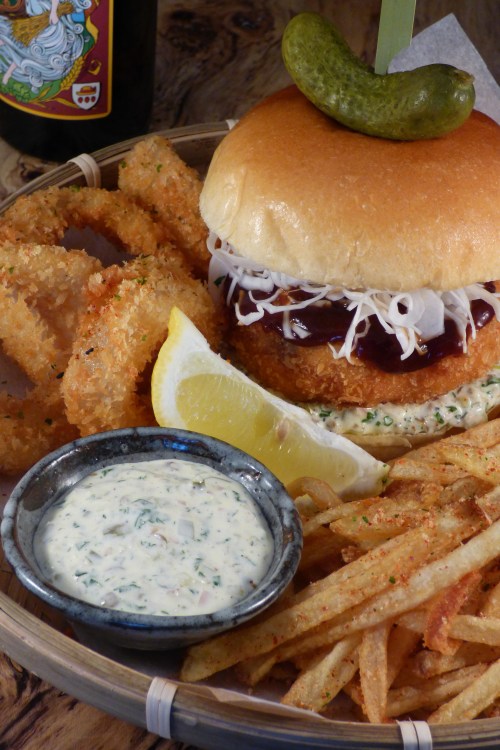
Food in Japan is divided into two distinct categories; Washoku, the native, traditional cuisine that dates back many hundreds if not thousands of years, and Yōshoku (or seiyōshoku), Western style dishes that started being imported into Japan’s culinary tapestry during the Meiji restoration.  Along with firm favourites such as karē, tonkatsu, and ramen, ebi furai- or breaded, fried prawns lie firmly within the yōshoku camp, probably owing their heritage to Portuguese traders who introduced crumb coated pork cutlets to Japan during the late 1880s.  Much later, an enterprising chef combined two of the most popular yōshoku, ebi furai and hambāgā to create an ebi katsu burger, chopped prawns shaped into a patty, breaded and then deep fried before being served in a soft buttery bun with the traditional furai accompaniments of tartare and tonkatsu sauces.   We’ve adapted this modern classic slightly by mixing our prawn meat with minced hanpen, a very airy fishcake made from pollock and nagaimo yam, which gives the burger a particularly light, bouncy, juicy texture without detracting from the sweet, delicate flavour of the prawn.

Onipote (a contraction of the words onion and potato) is a half portion of onion rings served with a half portion of fries, a dish we first came across in an Akihabara branch of MOSBurger, Japan’s largest fast food chain.  Why chose between both of these classic sides when you can have a little of each?  Rather than batter our onion rings we’ve opted for the same crunchy panko crumbs that we used on our ebi burger and then dredged both these and the super skinny fries with a sweet and spicy shichimi togarashi salt. Perfect!


ebi katsu burger
Ebi Katsu Burger- crisp breadcrumbs on the outside and juicy, sweet prawns on the inside.

Continue reading “Ebi Katsu Burger with Onipote”

Karē Udon

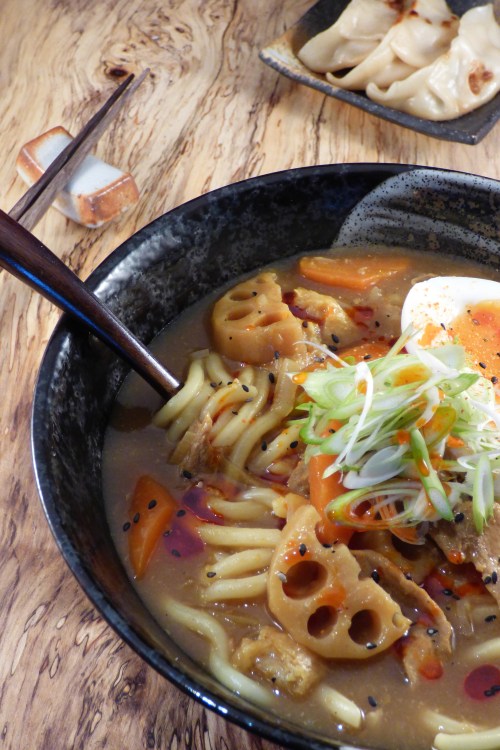
Finding inventive ways to make use of leftovers is a problem home cooks have no matter what country they’re in, so it should come as no surprise that Japanese cooks have been putting their excess portions of curry to good use for decades, stretching them out as fillings for doughnut like breads or turning them into soups.  Karē udon is a perfect example of this respectful attitude towards “waste” food, by adding leftover pork and vegetable curry to a fishy broth and some thick, chewy noodles you can create a wholesome, warming dish perfect for getting you through these freezing Winter nights.  It might not seem like the obvious choice to use a dashi based stock for this soup, but it creates a wonderfully rounded savoury flavour rather than anything particularly fishy tasting.  This combination of dashi, sake, mirin and soy sauce as a soup stock is known as mentsuyu, and is the classic starting point for many udon and soba dishes, even being used as a refreshing dipping sauce for cold noodles.

Karē udon, perhaps one of the country’s most popular comfort foods, has the same effect on the Japanese as a plate of macaroni and cheese might on an American or a bowl of hotpot on a Lancastrian.  It has the incredible power of evoking nostalgic memories of childhood, relieving emotional stress and giving a feeling of the security of being at home, somewhere you belong.  Not bad for a bowl of soup.

curry udon
Kare udon, why choose between curry and noodle soup when you can have both?

Continue reading “Karē Udon”

Mabodon

During the twentieth century a large number of Sichuan immigrants made their way to Japan, taking with them their own cuisine and eventually opening up restaurants catering to their fellow countrymen.  As time went on, the prickly, spicy dishes that the Sichuan province is famous for changed to suit the local tastes, gone were the copious amounts of dried chillies, pungent garlic and mouth-numbing peppercorns, instead replacing them with savoury miso, aromatic sake and sweet mirin.  One popular dish which received this transformation was mapo doufu or pock-marked beancurd; originally a sweat-inducingly hot, oil based sauce with pork and soothing pieces of beancurd to take the edge off the spiciness.  The Japanese version of the dish is a much more mellow affair, sweet and salty with a slight hint of chilli-heat, and a thicker, unctuous sauce.  This version of mabo tofu has found its place in Japanese cuisine as the nation’s favourite Chinese dish; in a similar way to Britain’s much-loved adaptation of Indian tandoori food, chicken tikka masala, it has evolved from its original form and become a fantastic dish in its own right.

A relatively modern etymological trend in Japan is the use of portmanteau in describing foods, such as anmitsu being a contraction of the words anko and kuromitsu, and in this case mabo tofu donburi- a bowl of rice with a topping- becoming simply mabodon.


mabodon
Mabo Tofu- sweet and spicy pork with tofu.

Continue reading “Mabodon”