Ninniku no Misozuke

Tsukemono- preserved vegetables- pop up nearly every time food is consumed in Japan but can easily go unnoticed; they’re served with sushi to cleanse the palate in between flavours, as a snack with beers after a long day at work, used to top a bowl of rice and garnish dishes or as a course all of their own in a traditional kaiseki meal.  These pickles help bring balance and harmony to a meal, they awaken the senses and excite the mouth preventing flavour fatigue and they add textures and colours that are otherwise missing from the foods that they accompany; samurai even used them for a quick energy boost during battle- and that alone is a good enough endorsement for me.

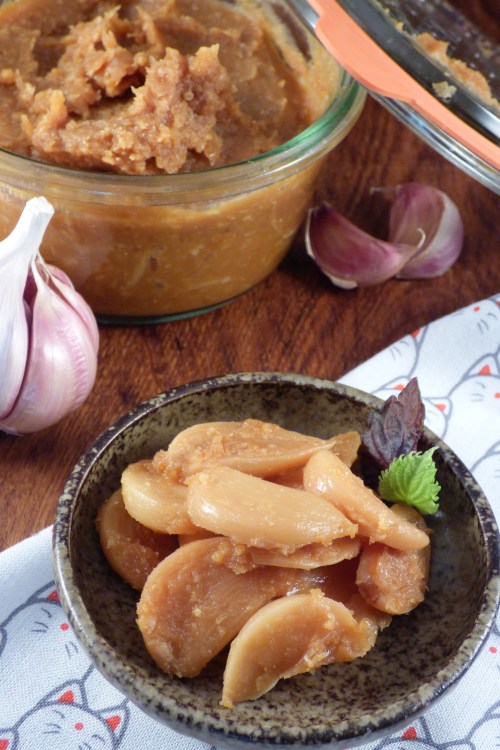
Unlike most Western pickles, those of Japan don’t rely purely on salt or vinegar to take care of the preservation of the main ingredient- tsukemono can be made with leftover lees from brewing sake, rice bran, mustard, soy sauce or as in this recipe, miso.  These misozuke pickles are perhaps the most intensely savoury of all the tsukemono, garlic cloves are buried in a finger-licking mixture of miso, sake and mirin before being left for months to slowly transform.  The miso helps temper the fiery flavour of the garlic which in turn mellows out the saltiness of the miso, resulting in two beautifully balanced condiments; a crunchy, umami-rich pickled garlic that’s a perfect accompaniment to meat or fish dishes, and a garlic enhanced nerimiso that’s just crying out to be stirred into a soup, spooned over hot steamed vegetables or smeared onto a crispy, lightly singed yaki onigiri.  Oishii!
 

ninniku
Ninniku Misozuke- deeply savoury, highly addictive miso-pickled garlic.

Continue reading “Ninniku no Misozuke”

Matcha tuile biscuits

The powdered Chinese green tea favoured by the Southern Song dynasty arrived on the shores of Japan in the late twelfth century, carried by the monk Eisai Zenji who had returned home from studying Chan Buddhism.  After two hundred years of being a purely religious beverage, Shogun Ashikaga Yoshimasa secularised the performance of making and drinking tea and it slowly evolved into the ritualistic ceremony we are familiar with today.  Whilst nearly every country the world over now drinks the later-developed steeped or infused tea, the powdered green tea known to us as matcha has remained a singularly Japanese drink, even being lost to the Chinese during the Mongol invasion.  The differences between the two types of tea are remarkable, to the extent that even some of the most enthusiastic of Western tea drinkers can sometimes find the deep green flavour and slight bitterness of matcha difficult or off-putting.  We’ve found that the easiest way to introduce the new and perhaps unexpected flavour of matcha to people is through desserts or baked goods such as these delicate, crisp tuile biscuits.  The buttery tuile batter and drizzle of rich, silky white chocolate help to balance out the mild astringent taste of the tea to create a biscuit perfect for snacking on or for accompanying a cup of your favourite brewed tea.


matcha tuiles
Crisp, buttery tuile biscuits, packed with the flavour of green tea.

Continue reading “Matcha tuile biscuits”

Duck Egg Chawanmushi

If you ever have the pleasure of eating in one of Japan’s more formal kaiseki ryōri restaurants, you’ll probably be served a futamono- “lidded course” between your sashimi and your grilled yakimono course.  Your futamono could be a small stew of seasonal ingredients, a soup such as a suimono, or our favourite, chawanmushi- a silky smooth treasure hunt of a dish.  Named after the lidded tea-cup or chawan that it is cooked in, chawanmushi is a wonderfully light, delicate egg custard, seasoned with dashi and mirin, and steamed until just set enough to encase and obscure the morsels trapped within its depths.  Each spoonful of custard is an edible lucky dip where you might bring up a firm ginkgo nut, a tender prawn, a juicy chunk of shiitake or a sour, palate cleansing bubble of yuzu pulp.

A popular, and to my mind almost compulsory addition to chawanmushi is a spoon or two of ankake sauce added moments before serving.  This mildly fishy, faintly smoky sauce adds an extra savoury oomph to each mouthful and helps you appreciate the sweetness of the steamed eggs.


chawan mushi
Duck egg chawanmushi- a lucky dip into savoury egg custard.

Continue reading “Duck Egg Chawanmushi”

Chāshūdon

Owing its heritage to char siu- the bright red, five-spice seasoned barbecued pork served in Cantonese restaurants, chāshū has become perhaps the world’s favourite ramen topping.  This is of course for good reason, meltingly tender succulent meat, braised at a low temperature for hours until the tough connective tissues and collagen have turned into silky soft gelatin, yielding to the slightest pressure from a chopstick.  The sweet, juicy layers of fat and moist, savoury meat are enhanced further by leaving them in a soy and sake seasoned broth overnight before being thinly sliced and seared in a hot pan to reawaken the glistening fats and juices hiding within the pork.

Chāshū isn’t only enjoyed with soup and noodles however, and one of our favourite ways to eat it is on top of a big bowl of rice as a chāshūdon.  Combined with other noodle toppings such as boiled eggs, pink pickled ginger and spicy Korean radish kimchi, you have a dish that gives you the same satisfaction as a deep bowl of brothy noodles but with a lot less effort.


chashudon
Chashudon- all your favourite ramen toppings, on rice.

Continue reading “Chāshūdon”

Teuchi Udon

Grain milling technology is said to have entered Japan during the thirteenth century when a Buddhist monk, Enni Ben’en, returned with it after studying meditation in China.  Along with that mechanical knowledge, he brought with him the idea that would eventually lead to the thick, white, toothsome, wheat flour noodle that we know today as udon.  Easily our favourite type of noodle, udon has enough character to be the main focal point of a dish, whether it’s a meal of chilled noodles with dipping sauce in the heat of the Summer, a plate of fried yaki-udon bought from a yatai at a festival or sunken deep in a bowl of smoky pork broth, topped with slow braised meat and a boiled egg.  There are some fantastic udon available to buy from supermarkets, even here in the UK, and they’re the ones we use day-to-day, but when we want something that little bit special, when you want the noodle to break free from its supporting role and be the star of the dish, nothing beats making them yourself.

Making noodles at home is a simple affair, requiring very few ingredients and not taking much time at all; kneading the dough is perhaps the only labour-intensive part of the process and that is made a lot easier by letting your feet do the work rather than wearing out your arm muscles.  The beauty of making udon yourself rather than buying them really lies in the ability to make them whatever size and shape you like- from the almost paper thin Himokawa noodles of Gunma Prefecture, to the finger-thick “Two Noodle” udon of Kyoto’s Tawaraya restaurant and everything inbetween.  Our preference lies somewhere towards the Ise udon end of the spectrum- larger and thicker than commercially available noodles, but not so fat that they take a whole hour to boil them.


udon
Homemade udon noodles, served bukkake style.

Continue reading “Teuchi Udon”

Homemade Furikake

Originally created as a calcium rich dietary supplement to combat malnutrition in the working classes and the soldiers of the First World War, furikake rice topping has since become a store-cupboard staple found in nearly every Japanese household.  First marketed by pharmacists during the 1910s, it went by many names including ‘Kore Wa Umai’ or ‘This is Good’ before it was christened furikake in the late 1950s.  Since then the make-up of the seasoning has evolved down multiple pathways creating an almost endless variety of flavours, nearly all of them based around the standard elements of seaweed, sesame seeds, salt and dried fish products.

The first step of many Japanese recipes is making dashi, a mellow broth of kombu and katsuobushi that forms a solid foundation upon which you base the rest of your dish.  Once the stock has been drained and used, the seaweed and bonito flakes are normally discarded, but they contain far too much flavour to simply throw away, so we like to recycle these unwanted ingredients into our own homemade furikake.  When combined with toasted sesame seeds, soy sauce and mirin the result is a deeply savoury condiment with a hint of smoky nuttiness that’s perfect for topping a bowl of hot steamed rice, mixing into an onigiri or even scattering over a fresh batch of popcorn.


furikake
Homemade furikake: rice’s best friend.

Continue reading “Homemade Furikake”

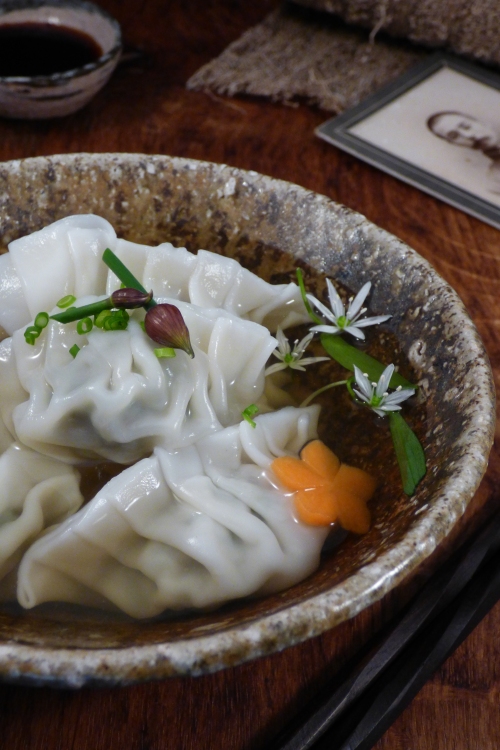
Ramson Gyoza Suimono

For me, spring only truly starts when the first foods of the season are ready to harvest or forage, and one of the plants that I most eagerly look out for each year is wild garlic or ramsons.  Ten minutes walk from our house is a small brook, its banks lined with a stretch of woodland that provides a welcome glimpse of nature among the noise and rush of the city.  Within the dappled light of these woods lies a patch of ramson plants, carpeting the edges of pathways and giving off their distinctive pungent aroma whenever they’re lightly brushed by a passing bird or walker.  The leaves of this shamefully overlooked and short-lived plant provide a powerful garlic hit along with a spring onion-like flavour that makes it perfect for mixing into dipping sauces and dumpling fillings, and if you’re lucky enough to find some plants with open flowers they offer up an edible garnish of such intense flavour you won’t believe it came from such a delicate looking thing.

Seasonality and the use of local produce are two of the main cornerstones of Japanese cuisine so these wild ramsons are the perfect ingredient to use in the kaiseki style dish of suimono or clear soup.  A delicate, lightly seasoned broth that allows you to focus on the flavours of the individual elements that it contains, in this case a pile of carefully crimped duck and wild garlic gyoza and a scattering of flowers and leaves from both the foraged ramsons and some young chives.

gyoza suimono
Clear soup with duck gyoza and wild garlic flowers.

Continue reading “Ramson Gyoza Suimono”

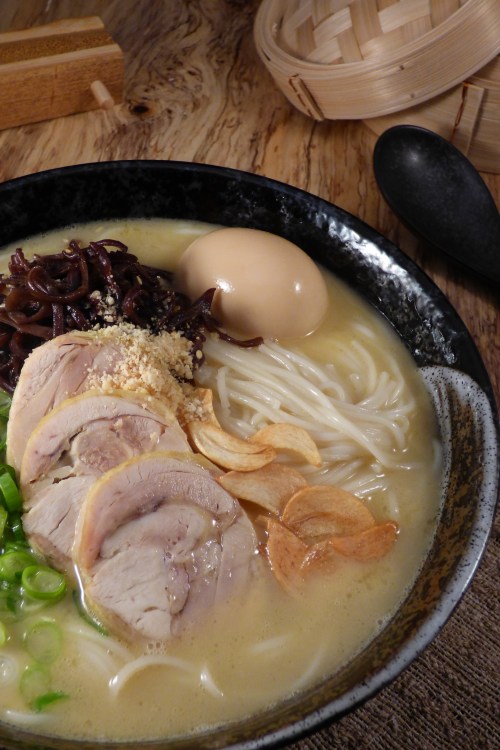
Tori Paitan Ramen

In the past few years tonkotsu has become the coolest style of noodles to be seen eating or making here in the UK; a thick, unrefined, intensely meaty broth, served with the regular gang of ramen toppings, chashu pork, boiled eggs and bamboo shoots.  Restaurants vie to see who has the longest simmered stock with the most opaque suspension of fat and collagen, while critics search for the ramenya with the softest pork and the most unctuous fat.  Worthy of equal praise and attention though, is the lesser known, neglected relative of tonkotsu, and one of the unsung heroes of the noodle world- Tori Paitan Ramen.  A richly satisfying, creamy broth of chicken bones, skin and cartilage, milky in appearance and sticky on the lips from the copious amounts of fat and gelatin present and the long periods of fierce boiling.  To accentuate the deep chickeny flavour of the broth, we’ve added lots of garlic in the form of fried garlic chips and a spoon of powerful, garlic infused duck fat which lends an intense muskiness and a brilliantly rich mouth feel to the finished soup.

A bowl of ramen wouldn’t be complete without some slow-cooked meat to top your mound of noodles, but rather than use the traditional pork, we’ve kept our paitan a purely poultry dish and created a torchon of chicken by wrapping together thigh and breast meat in a layer of skin.  When sliced thinly, this sausage of chicken makes the perfect topping for ramen and falls apart at the slightest pressure from your chopsticks.

tori paitan
Tori Paitan Ramen: The ultimate chicken noodle soup.

Continue reading “Tori Paitan Ramen”

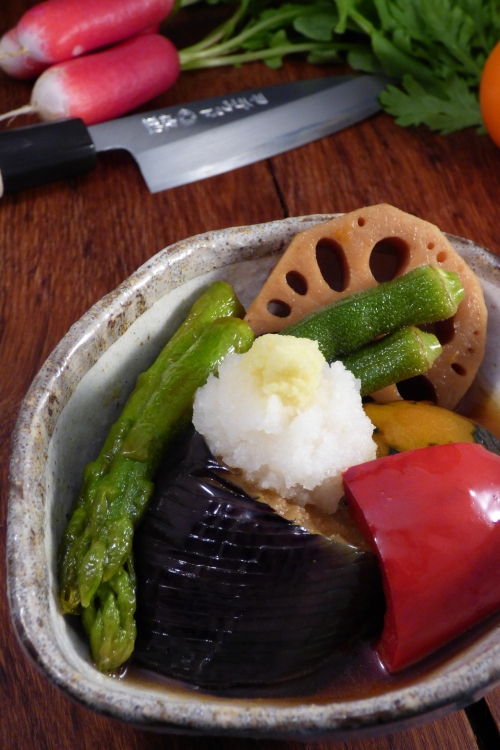
Yasai no Agebitashi

Every now and then you come across a side dish so vibrant, flavoursome and bountiful that it could be- and often is in our household- a main meal in itself.  Yasai no Agebitashi, or ‘fried and soaked vegetables’ to translate its name, is one such dish.  Nearly always made with aubergine as the main ingredient, a selection of firm vegetables are deep fried quickly without any form of coating, ‘suage’ style.  The fierce heat of the oil causes the insides of the vegetables to steam through before they get marinated in a sweetened dashi broth; the tender, cooked vegetables absorb the liquid like a sponge, carrying the flavour throughout.  This technique creates silky, creamy aubergines that melt in your mouth, while crisper vegetables like the lotus root and red peppers retain just the right amount of bite, providing a fantastic contrast of textures.  Topped off with a spicy mound of grated daikon and ginger to counter the richness of the vegetables and the sweetness of the broth, this is the perfect appetiser or side dish to go with nearly any meal, and by changing the dashi to a kombu broth you can easily make a vegan or vegetarian version.

agebitashi
Yasai no Agebitashi: Fried vegetables soaked in a sweet soy broth.

Continue reading “Yasai no Agebitashi”

Kitsune Udon

We’ve been visiting noodle restaurants for almost as long as I can remember, and have passed over a basic sounding dish on the menu many times, dismissing its simplicity in favour of the more showy, topping laden bowls.  That is at least, until a couple of years ago whilst on a lunchtime visit to a market in Kyoto, we stopped by an udonya and tried the curiously named Kitsune Udon (fox noodles) for the first time and became instant converts.  A deep bowl of perfectly cooked, thick white udon, a slightly smokey, fish based soup, and a single piece of inari-age, simmered in a sweet soy and mirin liquor until the sponge-like tofu had absorbed a massive amount of flavour.  The clean soup paired with the rich, sweetness of the tofu was an incredibly soothing combination, and one that we’ve tried to eat as often as possible since our first taste.

Many people like to add narutomaki or kamoboko to their kitsune udon -and feel free to if you want, they’re both delicious additions- but we like to keep ours uncomplicated and the way we’ve always eaten it in Japan; just the noodles, the broth, a sweet slab of toothsome inari-age and a mound of spicy, fresh spring onions.  Perfect comfort food if you’re feeling a little under the weather and great fuel for foxes on a night-time prowl.

kitsune udon
Kitsune Udon- a soothing bowl of soup topped with seasoned abura-age, the favoured food of Japanese foxes.

Continue reading “Kitsune Udon”