Anmitsu

Partially down to the way Japanese meals are structured, and partially because they tend to specialise in one type of dish and not stray far from that, many Japanese restaurants don’t tend to offer desserts.  When you do stumble across one that does serve a sweet course, a lot of the time it’ll be the perennial favourite, anmitsu.  At first glance appearing to be a fruit salad, the closer you look the more you start to notice key Japanese flavours and ingredients within it.  Sweetened red bean paste and green tea flavoured cream sit atop a mound of cubed kanten- clear water jelly made from red algae, and small round rice dumplings are anointed with a slick of kuromitsu black sugar syrup, before the whole dish is adorned with the selection of fresh or preserved fruits that first caught your attention. Shiratama dango are traditionally made from just rice flour and water, but we’ve added silken tofu to ours to make a softer, more delicate dango that dries out less and has an irresistibly bouncy, squidgy bite to it.  All of the elements combine harmoniously to create a very refreshing dish, perfect for eating after a particularly rich or spicy meal or it makes an excellent snack on a hot Summer’s day.
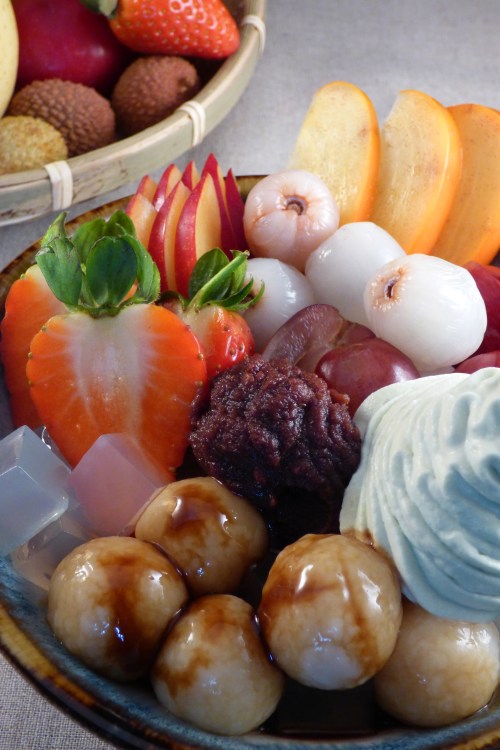
anmitsu
Anmitsu; beanpaste, syrup, riceballs, agar jelly and green tea cream.

Continue reading “Anmitsu”

Okinawan black sugar steamed cakes

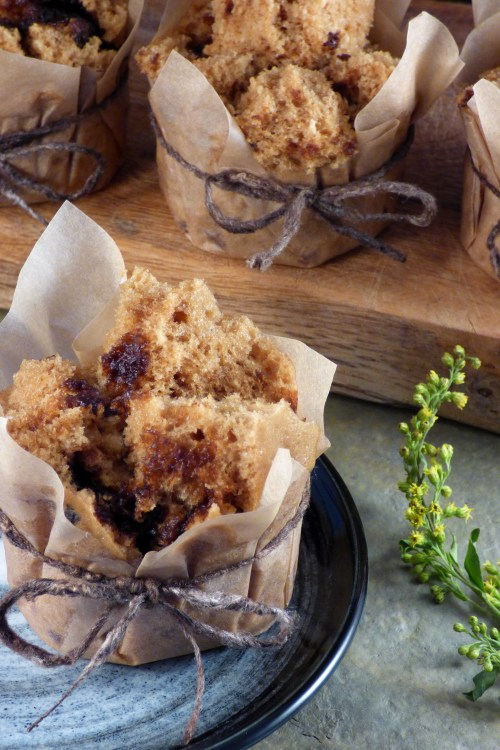
A dark, unrefined, deeply caramel flavoured ‘black’ sugar is cultivated and processed on the Southern Japanese island of Okinawa.  The almost constant sunshine, volcanic soils and nutrients provided by sea spray have created the ideal growing conditions for producing this mineral rich sweetener which has, quite naturally, found its way into a lot of both island and mainland Japanese cuisine.  Pieces of the dense, almost raisiny tasting sugar are often consumed as a sweet along with green tea, or used as a flavouring in rafute pork stew, but our favourite way to use it is in these steamed cakes that we first encountered in a Tokyo depachika.  Fresh from the steamer these light, airy cakes remind me of the geothermal, mountainous areas of Japan- their craggy, ruptured exterior, internal veins of rich gooey syrup and vents issuing jets of hot air.  They are best eaten greedily, while still scalding hot, to really enjoy the texture and contrasting flavours of the delicate dough and the random nuggets of sugar.


steamed cakes
Steamed cakes flavoured with Okinawan ‘black’ sugar.

Continue reading “Okinawan black sugar steamed cakes”

Okonomiyaki

Bearing more similarities to rösti or bubble and squeak than pizza, as it is often compared, okonomiyaki is to my mind one of the best ways to eat cabbage and a great example of wartime necessity creating fantastic food.  During World War II, when rice supplies were at their lowest, inexpensive wheat flour was made into a thick batter, mixed with shredded cabbage and fried as filling, savoury pancakes.  Seventy years and numerous adaptations to the original recipe later and we now have one of Japan’s most popular dishes.  Nagaimo (a type of yam from a climbing vine) is often added to the batter nowadays to enhance the consistency with its unique sticky, foamy texture.  If you can’t find nagaimo in an oriental supermarket, beating some air into the two egg whites in the recipe will help to make the okonomiyaki fluffier and closer to the real thing.

The word okonomi translates as ‘what you like’ and yaki to ‘grilled’, and as the name suggests, you can add whatever toppings you like to this dish, our favourite combination being prawns and smoked bacon.  Whatever extra ingredients you choose, just make sure to top the pancake with aonori seaweed, dried bonito flakes, Japanese mayonnaise and the punchy, fruity brown sauce known as sōsu or okonomi sauce.


okonomiyaki
Kansai style Okonomiyaki

Continue reading “Okonomiyaki”

Gojiru Setsubun soup

Oni wa soto! Fuku wa uchi!

According to the lunar calendar today is Setsubun- the day before the start of spring, a sort of New Year’s Eve. It is believed that at the start of a new year, the mortal world and the spirit world move closer together than normal, so spirits can wander more easily into our world. Because of this, people all over Japan take part in purification rituals to ward off bad fortune for the year to come, traditionally using fukumame (‘lucky beans’, roast soybeans) to chase demons and evil spirits from their homes and invite good luck in. These beans are either thrown out of the door or at a representation of an evil spirit- normally a member of the family, wearing an oni mask- whilst chanting “Oni wa soto! Fuku wa uchi!” or “Demons out! Luck in!” It is also traditional to eat a roasted soybean for each year of your life, plus an extra one for the coming year, to bring good health.

Soybeans are a ubiquitous part of Japanese cuisine, used in the production of tofu, soy sauce and miso amongst other foodstuffs. To commemorate Setsubun we’ve combined puréed soybeans and miso paste to make gojiru, a thick warming soup, full of vegetables, that’s sure to bring you health for the whole of the year.

Gojiru
Gojiru- Oni wa soto! Fuku wa uchi!

Continue reading “Gojiru Setsubun soup”

Asari no Sakamushi to Nasu Dengaku

After receiving a present of some sake from a friend, we wanted to have a dinner themed around the gift to make the most of it, and what better food to serve than two izakaya favourites, both steeped in the delicate flavours of rice wine.  The star of the meal was Asari no Sakamushi, a mountain of fresh white clams, steamed in sake flavoured with plenty of ginger and a pungent sprinkling of garlic chives.  As is the case with many other seafood-loving nations around the world, the Japanese know that the best way to treat shellfish is to not mess around and cook them quickly with a few aromatics and a splash of regional wine.  To go with the clams we chose a side dish of Nasu Dengaku- soft, creamy baked aubergines topped with a slick of sake-enhanced miso and a nutty crunch of toasted sesame seeds.  The grilled, slightly charred vegetable providing a pleasing contrast to the delicate, steamed clams and by cooking both of the dishes with the same sake that we were going to be drinking, we were able to keep a continuity of flavours running through the meal.

sakemushi clams
Asari no Sakamushi- sake steamed clams


Continue reading “Asari no Sakamushi to Nasu Dengaku”

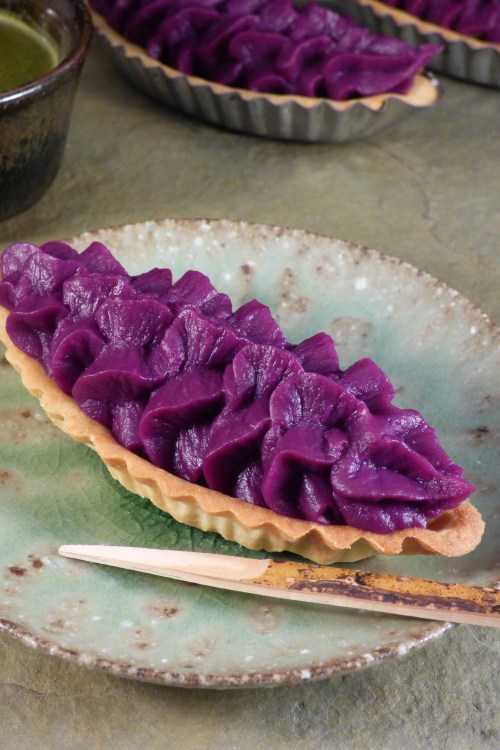
Murasaki Imo Tarts

Every now and then you come across an ingredient that you fall head-over-heels in love with, you cook everything imaginable with it and spend hours dreaming about how to get just one more recipe out of it.  For us, that ingredient is murasaki imo, or purple sweet potato.  Similar to the pale yellow or white fleshed sweet potatoes usually favoured by the Japanese, these purple potatoes have more dry matter than the orange fleshed American variety, and a much stronger taste.  A rich, fruity, almost winey flavour, an otherworldly, deep purple colour and the added bonus that they are packed full of vitamins make them a winner in our books for savoury dishes or desserts.

Japanese meals do not traditionally have a dessert course or end with something sweet.  The time for a sweet treat is at around either 10am or 3pm, as a contrasting flavour to go with the slightly bitter green tea that workers would normally stop for.  The confections served with tea vary from moulded higashi of sugar and rice flour to fresh fruits, and from jelly-like warabi mochi made from bracken starch to small French style cakes and tarts such as this Okinawan creation.  Murasaki imo is mashed, enriched with cream, butter and sugar then piped into crisp pastry cases, just enough for three or four bites before you get back to work.

murasaki-imo tart
Sweet potato pie, Okinawa style.

Continue reading “Murasaki Imo Tarts”

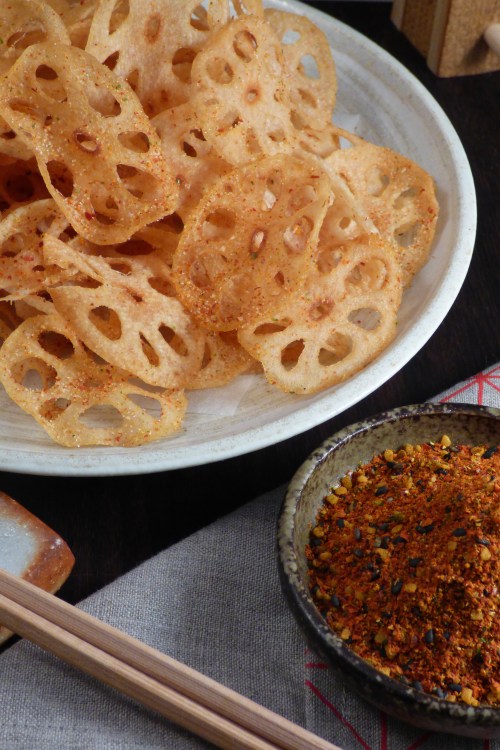
Renkon Chips with homemade Shichimi Togarashi

Dating back as far as the 1600s, shichimi togarashi is a vibrant condiment that started life as a medicine mixed by herb & spice dealers in Edo- old Tokyo- before becoming popular as a seasoning for food.  The combination of citrus, chilli and seaweed flavours make it a perfect accompaniment to slow cooked soups and fatty meats, or whenever you want to add a bit of freshness and heat to a dish.  There are many popular blends of shichimi togarashi (the name means ‘seven flavour chilli’ by the way) available on the market, but when made fresh at home it has a much brighter flavour, and of course you have the ability to tweak the recipe to your liking.

By mixing our shichimi with salt and sugar, we’ve made a delicious seasoning for an izakaya favourite- renkon chips.  With a flavour slightly sweeter than potato and a long history of being used medicinally, lotus root makes a perfect partner to the seasoning and when thinly sliced and fried as chips it makes a fantastic bar snack.

renkon chippu
Renkon chips dusted with our blend of spices, salt and sugar.

Continue reading “Renkon Chips with homemade Shichimi Togarashi”

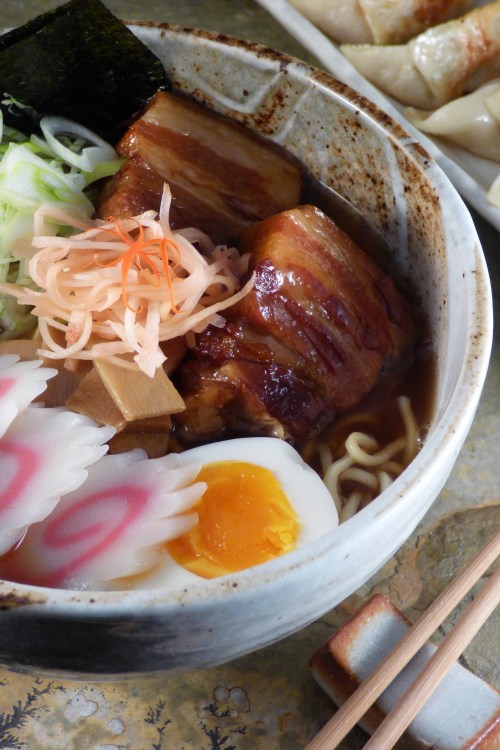
Shoyu Ramen

Few meals can match the allure of a rich, hot bowl of porky ramen.  Soothing, deeply flavoured broth, a tangled mass of slightly chewy noodles, slowly braised meat and a creamy boiled egg.  This now staple dish is only a relatively recent addition to the patchwork cuisine of Japan- the first ramen restaurant opened in Yokohama in 1910 and sold a simpler version of the dish called shina soba, or Chinese noodles.  Countless variations on the theme of broth, noodles and toppings have sprung up since then, many of them being extremely regional specialities that you’d have problems finding outside of a particular town.  Our favourite combination of ramen flavours is one that we’ve eaten many times in Tokyo; a soy flavoured pork broth, straight noodles, a pile of shredded spring onions, a few slices of fishcake, a boiled egg, stewed bamboo shoots and most importantly, fatty, yielding, slow cooked pork belly.  We’ve borrowed an idea from David Chang’s recipe for ramen by adding some bacon to the broth for an irresistible smoky note and to boost the pork flavour.

Making ramen at home isn’t a particularly difficult affair, but it does take a long time.  Cooking the broth and the pork are the most time consuming parts, and they’re also the components that you’ll most likely want to get just right- the broth is really the star of the show and worth every minute you can put into it, no amount of flashy toppings can make up for a bowl of ramen with under-flavoured soup.  Both the pork and broth can be made in advance and stored in the refrigerator for three to five days for convenience, once you have those ready you can put together all manner of ramen dishes in very little time.

ramen
Ramen- noodle soup Tokyo style.

Continue reading “Shoyu Ramen”

Buta no Kakuni

In October 2010, in a small unassuming restaurant in Kyoto, I tasted a dish which has haunted my heart ever since (so much so that we named our blog after it).  A small hand formed brown kyo-ware bowl, lined with a single shiso leaf, a spoonful of sweet cooking liquid and three cubes of pork belly, braised for hours until the layers of meat, gelatinous skin and fat had reached a meltingly soft texture unlike anything I’d eaten before or since.  After some research, we discovered that this beautifully yielding showcase of pork belly at its best was known as Nagasaki pork, or Buta no Kakuni.  Kakuni probably started off as a Chinese dish called Dongpo pork, and in its migration to Japan the flavours evolved to suit the local tastes of Kyushu while keeping the same cooking techniques used for centuries prior.

We’ve spent years trying to match the flavour of the kakuni we first encountered in Kyoto, and have finally got it just right.  Although we haven’t been able to find a source of shiso leaves here in the UK, we’ve accompanied our kakuni with some young flowering leeks and a dab of tobanjan to give a spicy, fresh counterpoint to balance out the rich pork.

P1040328
Buta no Kakuni- square simmered pork

Continue reading “Buta no Kakuni”

Gyuu Tataki to Yuzukosho Modoki

Raw fish in the form of sashimi is quite often the first thing a foreigner thinks of when you mention Japanese food, but perhaps less well known is gyuu tataki, a lightly cooked piece of beef fillet that while seared on the outside remains completely raw in the centre.  We’ve paired our beef with a couple of citrussy accompaniments, firstly a home-made take on yuzukosho (we’ve used the word ‘modoki’ in the title, which means pseudo or mock) and then with a ponzu style dipping sauce made of lime juice and soy sauce.

Yuzukosho is a fantastically strong, fiery condiment used mainly with hotpot dishes and sashimi, made from fermented citrus fruit and green chilli peppers.  Yuzu- the traditional fruit used in the seasoning- is unfortunately for us very hard to come by in England, so we have combined a number of different fruits to craft a flavour reminiscent of the complex aroma the original has.  This zesty paste brings together sour, bitter, floral, salty and spicy flavours which all balance the beef’s natural earthiness and when used as an appetiser at the start of a meal really awakens your palate.

tataki
Seared beef with citrus and chilli yuzukosho.

Continue reading “Gyuu Tataki to Yuzukosho Modoki”