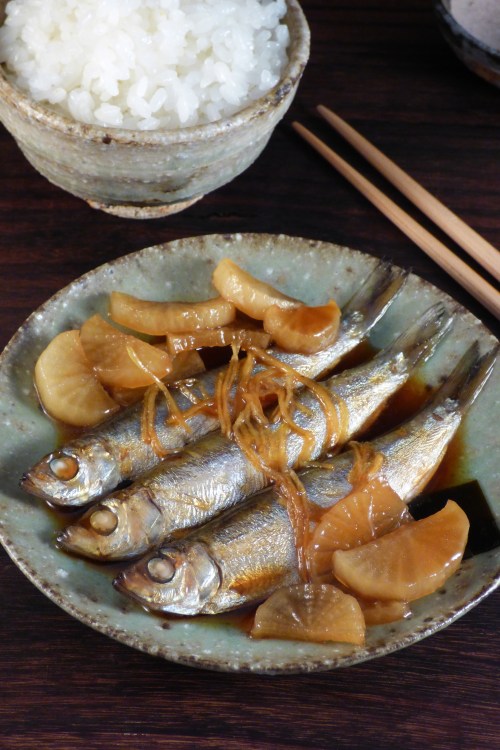
Supuratto no kanroni / Iwashi no kanroni

Being an island nation, Japan has always consumed a huge quantity of seafood, and up until recently this has also been true of the British Isles, a tradition that we’re sadly losing.  Whilst shopping in our local fish market we came across some beautifully fresh sprats, a very typical fish in classic British cuisine and knew we could use them to make something very Japanese.  Sprats, as with most small fish, have fallen out of favour in recent years as people tend to prefer larger fish with fewer bones, however they’re packed full of omega oils and B-vitamins and their flavour is well worth the little extra effort.  As sprats are from the same family, these little oily fish are a perfect substitute for the sardines that would normally be used in this old fashioned dish of daikon, ginger, fish and a sweet sticky sauce.

An old Japanese trick to cook oily fish with sake to lessen the strong odours is used in this recipe, and the spicy shards of ginger cut through the richness.  If you can’t get hold of sprats then use sardines and allow 2-3 fish per person for a main course.
Kanroni
Supuratto no kanroni: Little fish, big flavours.

Continue reading “Supuratto no kanroni / Iwashi no kanroni”

Shiozake Yaki-Onigiri

An onigiri (rice ball) is to Japan as a sandwich is to England.  It’s a filling and cost effective replacement for a real meal that you can grab from any convenience store before jumping on a train or rushing back to the office to work through your lunch break.  Often, you can improve a sandwich by grilling it, creating a crispy golden exterior that gives way to a warm soft inside.  By that same logic, grilling an onigiri gives you a delicious treat that enlivens a go-to snack and raises it to a new place. We have filled ours with an onigiri classic; shiozake, a kind of semi-cured salmon which we’ve infused with sake and sweet mirin.  These yaki-onigiri have an outer crust that tastes almost like a toasted senbei cracker glazed with sweet soy sauce, while the inside resembles a warm gravlax or smoked salmon.

yakioni
Crispy grilled onigiri, stuffed with sake infused salmon.

Continue reading “Shiozake Yaki-Onigiri”

Two side dishes- Tataki Kyuri & Chikuwa to negi no sarada

One of the most enjoyable things about a Japanese meal is the sheer number of plates and bowls you get, little plates of pickles, bowls of dipping sauce, salads and small vegetable sides.  In a restaurant you can think you’re ordering one basic dish and then end up with seven or eight little portions on your table per person.  In this post we’ve got recipes for two such dishes; a punchy, strong pickled cucumber, powerfully seasoned with raw garlic, and a fresh salad of chikuwa fishcake mixed with spring onions and red peppers, topped with dried bonito shavings.


chikuwa
Smashed cucumber pickled with garlic & Chikuwa salad with spring onion.

Continue reading “Two side dishes- Tataki Kyuri & Chikuwa to negi no sarada”

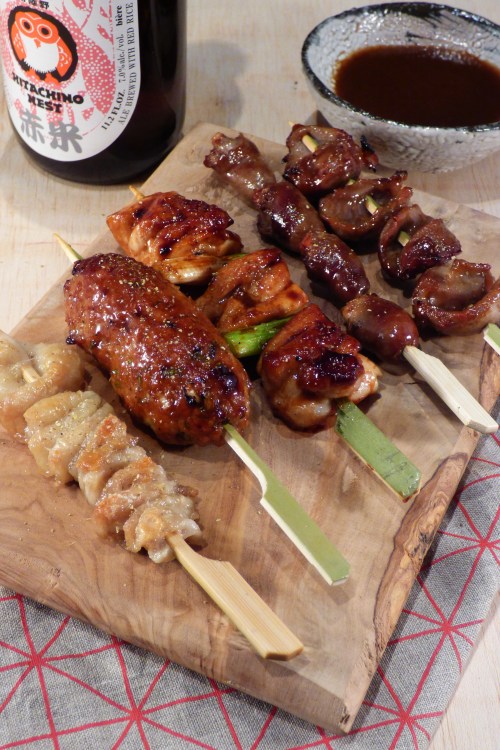
Yakitori assortment

Perhaps Japan’s most ubiquitous bar food, or at least the one most well known outside of Japan, yakitori is a firm favourite with us.  Visiting a traditional yakitoriya is a daunting experience, normally lacking in menus, the bill of fare is hung from banners near the ceiling written in kanji completely indecipherable to most westerners, but they offer a fantastic insight into how the locals wind down after work.  Charcoal grilled chicken, offal and skin, served on sticks, glossed over quickly with a brush dipped in an almost magical concoction of drippings and soy sauce, the perfect accompaniment to a beer, or two.

yakitori
Yakitori, L to R: Skin, tsukune, thigh with spring onions, hearts, gizzards.

Continue reading “Yakitori assortment”

Two ways with kabocha (kabocha namul & kabocha no miso)

With Autumn being our favourite time of year it only stands to reason that kabocha squash, being such an Autumnal vegetable, is one of our go-to ingredients when we want to eat something Japanese and comforting.  Kabocha, with its sweet yet savoury flavour makes a great main component for a meal, but works just as well as a side dish or a splash of colour in a bento.  These recipes work well with butternut squash or most other hard skinned winter squashes (crown prince is a really good match for kabocha in both flavour and texture, but it’s probably best to peel its harder outer skin away)


Kabocha Namul.

Namul (or namuru) is a family of dishes of Korean origin; shredded vegetables, seasoned with sesame and served as a side dish.  This namul works really well as a side dish to rich, sweet meat dishes such as buta no kakuni, and its nutty flavour contrasts extremely well with vinegared foods or those served with a ponzu dipping sauce.  It even makes a great coleslaw substitute in sandwiches.

kabocha namul
Kabocha Namul, delicious served with Buta no Kakuni.

Continue reading “Two ways with kabocha (kabocha namul & kabocha no miso)”