As was the case across much of the world, sugar didn’t become widely available in Japan until the late 1800s- it was an expensive luxury ingredient exclusively for the kitchens of the wealthy and was used by artisan craftsmen to create elegant desserts and sweets. Outpriced by the upper classes, the sweet cravings of everyone else were instead satisfied by a uniquely Japanese ingredient; a mellow, toasty, nutty, yellow flour called kinako. Made from finely ground roasted soy beans, kinako has a delicate sweetness, much more subdued than that of sugar, but more than just sweetness, it imparts a wonderful flavour of its own wherever it is used- a distinctive, warming, caramelly mixture of freshly popped corn and roasted nuts. Typically used as a powdery topping for sticky rice cakes like daifuku, warabi mochi bracken jellies, or heaped atop a mound of snowy shaved ice, kinako also makes a fantastic flavouring for baked treats like airy chiffon cakes and impossibly light French style cookies.
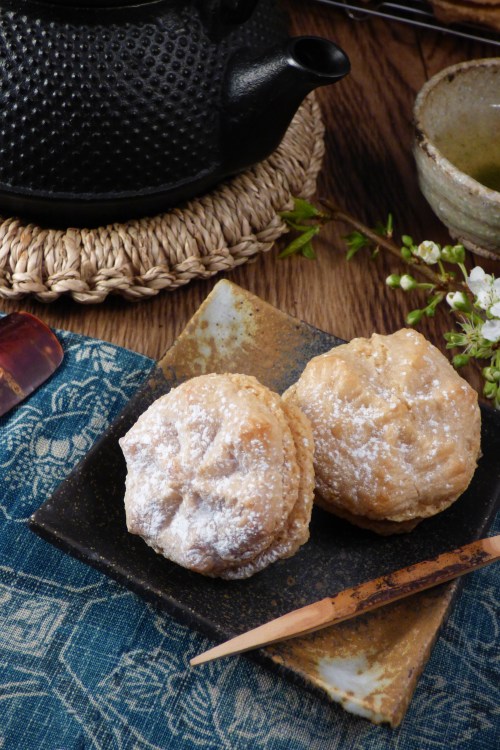
When one thinks of French cookies, macarons are normally the first image that springs to mind- the perfectly round sandwiched confections, with their shiny, smooth outer shell and concealed creamy centre- and, while kinako does make for an exquisitely flavoured macaron, I’d much rather eat this humble powder in a gutsier, less delicate form. That form is in the macaron’s unassuming, rustic country cousin, the dacquoise. More straightforward to make than a macaron, the dacquoise uses much of the same ingredients and techniques- folding ground almonds and icing sugar into beaten egg whites- but produces a much cakier cookie, with a meltingly chewy centre and a craggy crisp exterior. The nutty aromatic toasted kinako pairs wonderfully with the almond in the cookie shell, and the brown sugar in the silky buttercream filling heightens the rich, warming, caramel flavours. Despite their homely appearance, these dacquoise make a fantastic addition to an afternoon tea or packed as part of a picnic for your next blossom viewing party.

 kakuni