Ramson Gyoza Suimono

For me, spring only truly starts when the first foods of the season are ready to harvest or forage, and one of the plants that I most eagerly look out for each year is wild garlic or ramsons.  Ten minutes walk from our house is a small brook, its banks lined with a stretch of woodland that provides a welcome glimpse of nature among the noise and rush of the city.  Within the dappled light of these woods lies a patch of ramson plants, carpeting the edges of pathways and giving off their distinctive pungent aroma whenever they’re lightly brushed by a passing bird or walker.  The leaves of this shamefully overlooked and short-lived plant provide a powerful garlic hit along with a spring onion-like flavour that makes it perfect for mixing into dipping sauces and dumpling fillings, and if you’re lucky enough to find some plants with open flowers they offer up an edible garnish of such intense flavour you won’t believe it came from such a delicate looking thing.

Seasonality and the use of local produce are two of the main cornerstones of Japanese cuisine so these wild ramsons are the perfect ingredient to use in the kaiseki style dish of suimono or clear soup.  A delicate, lightly seasoned broth that allows you to focus on the flavours of the individual elements that it contains, in this case a pile of carefully crimped duck and wild garlic gyoza and a scattering of flowers and leaves from both the foraged ramsons and some young chives.
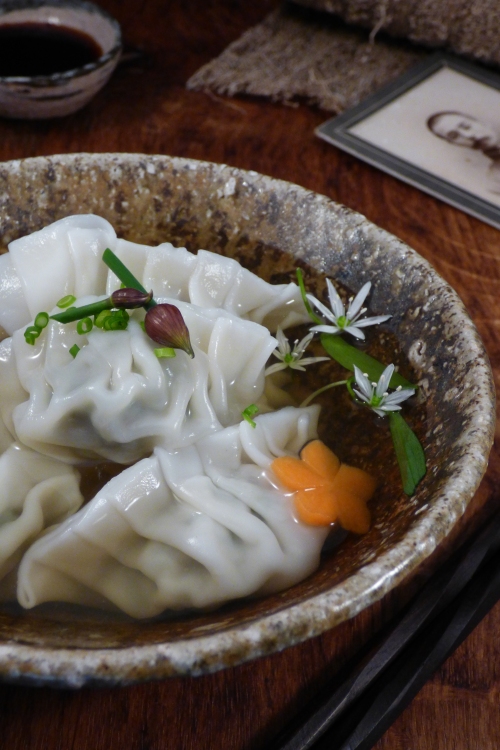
gyoza suimono
Clear soup with duck gyoza and wild garlic flowers.

Continue reading “Ramson Gyoza Suimono”

Kamo Nanban Soba

The wonderfully rich, slightly gamey flesh of duck and the intense earthy, woodland flavour of mushrooms are one of the most natural and instinctive combinations in cookery.  It’s a pairing you might expect to see in Italy, Russia, Sweden or France; countries that used to be blanketed with dense forests and vast lakes, countries that have a deep folklore and long history of woodsmen, making their living from what nature provides.  All of these features are equally true of Japan, and unsurprisingly the Japanese made the same discovery early on, that marrying wild duck with foraged mushrooms was a union worth remembering.  The other classic Japanese accompaniment to duck are the buckwheat noodles known as soba.  Deliciously nutty in flavour and with a slightly toothsome texture, soba are one of the oldest known types of noodle in Japanese cuisine, dating back over 2500 years to the Jōmon period and even further in Chinese cookery where they probably originated.

We’ve combined all three of these ingredients in a classic Kamo Nanban Soba- a dish that smells and tastes like a stroll through an ancient forest; with rich, life giving soil and a wealth of fungus sprouting from the crumbling trunks of fallen trees.  It wouldn’t be a kamo nanban without some sweet, charred spring onions, and to lift the earthy flavours slightly we’ve added a tiny hint of orange zest, perfect for cutting through the richness of the duck fat.

kamo soba
Kamo Nanban Soba- A woodland stroll in a bowl.

Continue reading “Kamo Nanban Soba”