Asa Teishoku

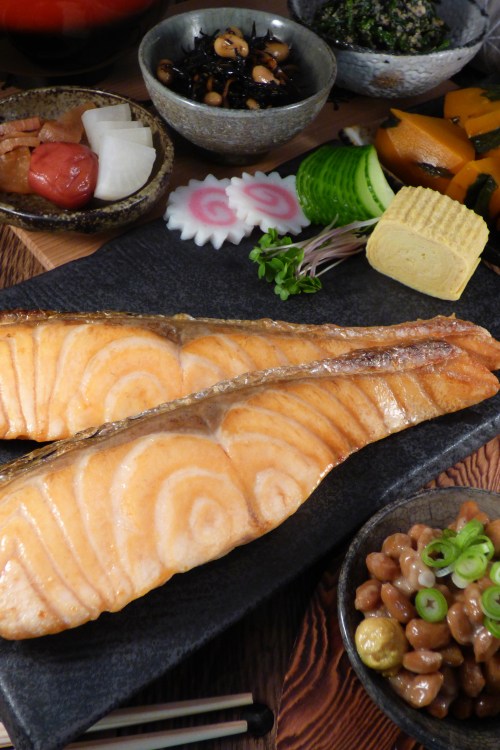
If time allows in the busy schedules of modern city living, one of the most harmonious and revitalizing meals you could possibly enjoy can be found in the traditional Japanese breakfast, or asa teishoku.  Built around the structural concept of ichijusansai, meaning one soup and three dishes, the standard spread for a Japanese breakfast includes miso soup, salted grilled fish, a piece of rolled omelette, and a couple of small vegetable dishes, all accompanied by the ubiquitous bowl of rice and plate of pickles.  Much like a full English breakfast it contains all of the necessary nutrients and calories for a productive morning’s work, but unlike its British cousin doesn’t make you sluggish or weigh you down with unwieldy amounts of meat, and it even contains a large amount of your daily recommended fruit and vegetable intake.

At first glance, a breakfast feast of nine or more components may seem like far too much work to undertake on a day-to-day basis (and in many respects it is- most modern Japanese people now eat a Western-style breakfast of bread or pancakes more often than a traditional spread) but most of the dishes are served either cold or at room temperature so can be made in advance and kept refrigerated until required, with only the soup and rice really needing to be cooked fresh in the morning.  All of the dishes from this typical breakfast also work incredibly well when used in a bento lunch or as side dishes to an evening meal.
wachoshoku
Asa Teishoku- the Japanese way to start the day.

Continue reading “Asa Teishoku”

Chirashizushi

The four heavenly creatures in Japanese mythology are: Seiryu the blue-green dragon, Suzaku the vermilion bird, Byakko the white tiger and Genbu the black turtle.  They govern over the four points of the compass, appear as major constellations in the night sky, embody four of the five classical elements and are representatives of the four seasons.  These godly animals are honoured annually with festivals held for each of them throughout Japan, but their presence can also be felt watching over you more subtly during other times of the year, if you know where to look.

One of the most well known events of Spring is Hinamatsuri, or Doll’s day- red fabric-draped platforms appear in houses, shrines and businesses, and atop these pedestals sit ornamental dolls in the form of the Emperor, Empress, ministers, musicians and other courtly attendants.  People celebrate, pray for the health and happiness of girls in their family, drink shirozake, and most popularly, eat bowls of seasoned rice strewn with a confetti of celebratory toppings.  Literally meaning ‘scattered sushi’, chirashizushi -whilst not only being delicious- pays tribute to the four heavenly creatures by means of their respective colours; blue, red, white and black, all of which are present in the toppings: crisp, tangy vinegared renkon for Byakko; savoury, umami packed shreds of nori and mushrooms for Genbu; crunchy, fresh pieces of mangetout for Seiryu; and finally the saline, bursting bubbles of ikura for Suzaku.  Like the dolls of the festival, these toppings perch on a carpet of shredded sweetened omelette, laid over a platform of seasoned su meshi rice, creating a meal perfectly balanced in textures and flavours.

By far one of the simplest sushi dishes to make in the home, chirashizushi doesn’t require any of the precision slicing or delicate wrapping of seaweed commonly associated with the cuisine, yet it makes a fantastic, vibrant dish to bring to the table for celebrations of all kinds.  It also works incredibly well packed as a bento lunch for those special occasions when you won’t be at home, and is perfect for taking to a tranquil spot in the countryside for a leaf or blossom viewing party.

chirashizushi
Chirashizushi- glistening pearls of salmon roe scattered over sushi rice.

Continue reading “Chirashizushi”

Tako no Nanbanzuke

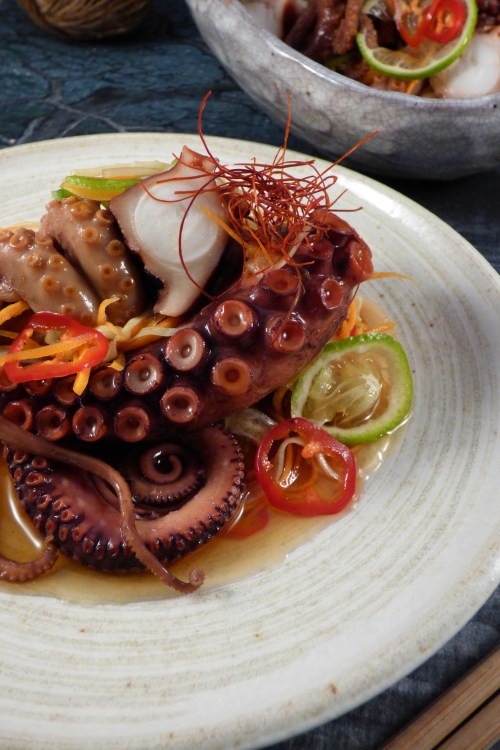
Whilst under Shogunate rule during the sixteenth and seventeenth centuries, trade and interaction with the outside world was tightly restricted, borders were sealed and Japan effectively became a closed country.  A closed country that is, except for the port of Nagasaki on the western coast of Kyūshū, a bustling hub for the importing and exporting of produce, people and ideas.  Much of the trade through Nagasaki was conducted with the Portuguese who were expanding their empire from Lisbon via the coasts of Africa, the Middle East and Goa.  These Nanban- Southern Barbarians- brought with them the Christian church, the technology to make firearms, foods like peppers, chillies and vinegar, and new cooking techniques such as deep frying in breadcrumbs and batter, all of which were assimilated quickly by the locals.  One of Portugal’s most popular methods of preserving fish for long journeys- escabeche, proved to be a huge success when tasted by the Japanese and has remained a favourite ever since.  Literally meaning ‘pickled in the southern barbarian style’, nanbanzuke normally refers to whole fried fish or fillets soused in a vinegary sauce with vegetables, but we’ve enjoyed it many times with octopus- another staple of the travelling Europeans.

In our version of nanbanzuke we poach a whole octopus until tender, then marinade it with a selection of crunchy vegetables in a mixture of fish stock and rice vinegar with plenty of spicy red chilli and ginger to add some fieriness.  Served at room temperature, nanbanzuke makes a wonderful addition to a picnic lunch, or when chilled it’s the perfect dish to serve in the summer when all you want to eat is something cooling, light and refreshing.


tako no nanbanzuke
Tako no Nanbanzuke- pickled octopus, the barbarian way.


Continue reading “Tako no Nanbanzuke”

Tai-Meshi

Sea bream or Tai is without a doubt Japan’s most beloved fish.  Being a symbol of good fortune it is traditionally served during celebrations, which is alluded to in the term ‘medetai’, a phrase used to congratulate people on auspicious events.  During the Edo period tai was so prized that it was reserved almost exclusively for the tables of the wealthy and a market solely trading in this king of fish was even set up in Osaka.  Lucky bream shaped sweets are a popular favour handed out at Japanese weddings, and the hot, sweet, bean-filled pancakes called taiyaki can be bought at stalls and cafés all over the country.  Ebisu- one of the traditional seven gods of fortune, is portrayed holding a fishing rod in one hand and carrying a huge red tai in the other.  It is the symbol of wealth, prosperity and high quality; it even spoils at a slower rate to other fish thanks to the high levels of inosinic acid present in its flesh, making it an excellent choice for sashimi.

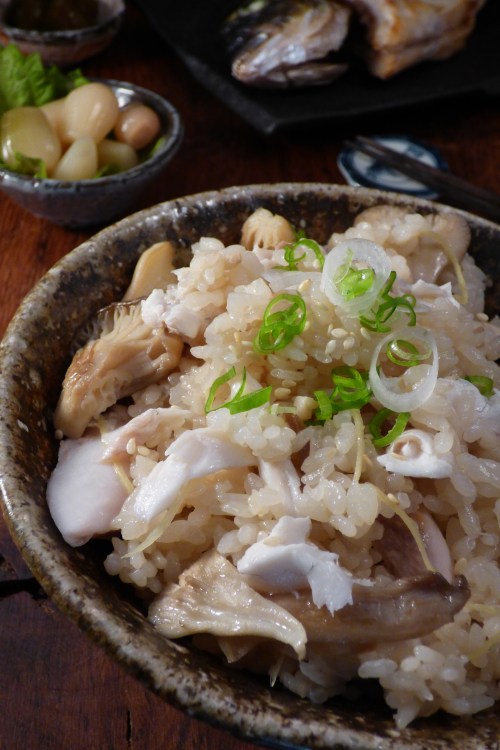
One of the best ways to enjoy this luckiest of fish is in this ‘surf & turf’ inspired takikomi gohan; the sweet, succulent pearly flesh of the tai is paired with meaty, earthy mushrooms and the spicy freshness only ginger can provide, to create a deliciously savoury rice dish that borders on the decadent.  We’ve used a selection of our favourite mushrooms in this recipe, some frilly, some dense and some tender, but feel free to use whatever is available locally to you.  If you’re fortunate enough to have some of the highly sought after, distinctly flavoured, matsutake mushrooms, they would make a phenomenal addition to your tai-meshi, combining both the country’s favourite fish and fungus into one memorable dish that spells out what the Japanese value most in food.


taimeshi
Tai Meshi- mushroom and ginger rice, cooked with the king of fish.

Continue reading “Tai-Meshi”

Sabazushi

Transporting fresh fish from the coast of Japan to its major inland cities was almost impossible before the advent of refrigerated trains; the days required to travel by horse resulted in inedible, spoiled goods unfit for the population of the Kansai region.  The only reliable means of getting fish to the then-capital city of Kyoto was to preserve it in some way- fermenting the fish in rice was popular, which extended its shelf-life to six months or more but altered the flavour dramatically.  In this early form of sushi, the rice was discarded and only the soured, preserved fish was eaten; it would take another three or four hundred years until the mid 1600s for a version with edible rice to evolve.  As the techniques for making sushi developed, the preservation of the fish improved but palates accustomed to the old style dishes yearned for the sour tang and started adding vinegar to the rice, creating the seasoned sushi rice we know and love today.

Sabazushi, still one of Japan’s most popular forms of sushi, lies comfortably between the fish preserving necessities of old that led to the development of sushi and the modern, perfectly crafted slices of fish atop vinegared rice that spring to mind as this most ubiquitous Japanese delicacy.  Glistening, iridescent, tiger-striped fillets of mackerel are salted and lightly cured before being wrapped over a pillow of seasoned sticky rice and sliced into perfect, jewel topped pieces.  Traditionally in Osaka, you would press this in an oshizushihako box mould to create a rectangular block, but we prefer to make it Kyoto-style and shape it by hand so you can appreciate the naturally domed top that the fish forms.  Whether you press it or not this makes a plate of beautiful, two-bite sized morsels; delicate, refreshingly tangy and with just enough of the rich, creamy fattiness that we love mackerel for.


battera
Sabazushi- rich, smooth, tangy and tiger-striped.

Continue reading “Sabazushi”

Unadon to Samphire Gomaae

Hugely popular from its creation in the late Edo period, to modern times, Unadon- or Unagi Donburi to give the dish its full name- is one of the most common ways to eat freshwater eels in Japan.  An oversized lacquer bowl, a mound of perfectly cooked, pearly white rice, and a fillet of eel, glazed to a rich mahogany colour with a mixture of soy and mirin, caramelised and slightly charred.  The first time we ate unadon was early one Summer’s morning in Shibuya.  After a dawn visit to the Meiji shrine complex we needed a hearty breakfast to boost our flagging energy, knowing little Japanese at the time we stumbled across a restaurant that was open where we recognised the word for ‘eel’ and decided to give it a go.  It proved to be the ultimate reviver, the sugary, salty kabayaki glaze along with the big hit of protein and fat got us back on our feet in no time and it has gone on to become one of our favourite breakfast dishes.

Despite being traditionally eaten all over the UK, getting fresh eels nowadays is a little difficult, so over the years we’ve experimented with cooking different native fishes in the kabayaki style.  The closest match we’ve been able to find is the locally abundant garfish, long and silvery with a fine flesh and just a little fat, it even looks pretty similar to an eel and should be easy to get hold of in most fishmongers.  Whilst at our fishmongers we also saw some beautiful samphire for sale and knew that this vibrant, salty, shoreline succulent would make the perfect gomaae accompaniment to the unadon; while these are both classic breakfast dishes, they’re delicious for any meal of the day.

unadon
Unadon served with sesame dressed samphire.

Continue reading “Unadon to Samphire Gomaae”

Supuratto no kanroni / Iwashi no kanroni

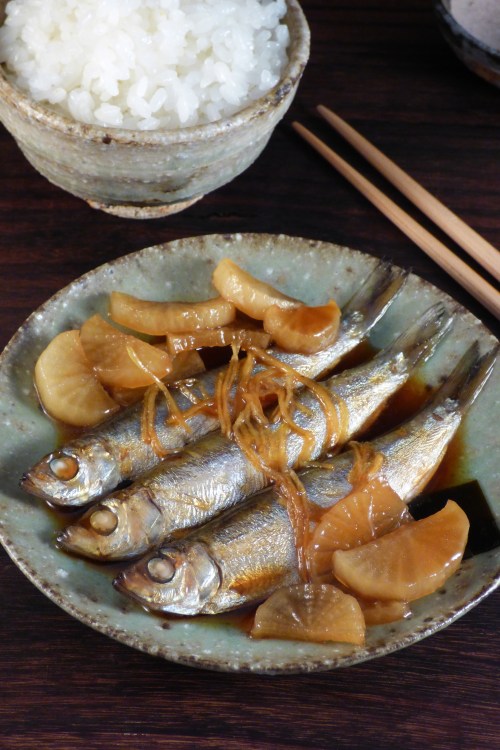
Being an island nation, Japan has always consumed a huge quantity of seafood, and up until recently this has also been true of the British Isles, a tradition that we’re sadly losing.  Whilst shopping in our local fish market we came across some beautifully fresh sprats, a very typical fish in classic British cuisine and knew we could use them to make something very Japanese.  Sprats, as with most small fish, have fallen out of favour in recent years as people tend to prefer larger fish with fewer bones, however they’re packed full of omega oils and B-vitamins and their flavour is well worth the little extra effort.  As sprats are from the same family, these little oily fish are a perfect substitute for the sardines that would normally be used in this old fashioned dish of daikon, ginger, fish and a sweet sticky sauce.

An old Japanese trick to cook oily fish with sake to lessen the strong odours is used in this recipe, and the spicy shards of ginger cut through the richness.  If you can’t get hold of sprats then use sardines and allow 2-3 fish per person for a main course.

Kanroni
Supuratto no kanroni: Little fish, big flavours.

Continue reading “Supuratto no kanroni / Iwashi no kanroni”