Motsunabe

Though not particularly prevalent in northern Japan and around Honshu, the south western island of Kyushu embraces the nose to tail ethos of consuming animals and has restaurants dedicated to beef and pork offal, or horumon, which you would be remiss not to visit if an opportunity arises.  To most westerners, the term offal conjures up thoughts of tough, gamey, questionable tubes hidden amongst favourable cuts of meat, perhaps encased within a pastry crust, or smothered in so much gravy that you can’t distinguish what you’re eating.  This is not the case with Japanese offal however- nearly always coming from prime wagyu cows, the organs have a rich beefy flavour, a tender bite and a slight underlying sweetness, and are generally served up in one of two popular ways:  horumon-yaki, where delicate cuts of heart, diaphragm, stomach and cheek are grilled quickly over a charcoal brazier before being plunged into a dipping sauce and eaten scaldingly hot, or as the Fukuokan speciality, motsunabe.

Motsunabe is the soul food of the Hakata district- diners huddle around a hotpot perched on a portable gas stove, the pan containing a mound of peppery white cabbage, a lightly sweetened soy based stock, short lengths of pungent garlic chives and the star of the show, beef small intestines.  The offal itself has a meltingly soft consistency, a pleasingly fatty bite and a rich, almost buttery flavour which pairs wonderfully with the vegetables and the ubiquitous cubes of tofu that you couldn’t have a nabe without.  After the chunks of vegetable, meat and tofu have been greedily picked from the pot and eaten, the heat is turned up beneath the broth and fresh ramen noodles are added to the boiling liquid, cooking in a matter of minutes, soaking up the meaty flavours of the motsunabe and thickening the sauce.  For me, this shime or ‘finishing course’ is the most anticipated part of the meal, an extra chance to savour the essence of the nabe and a final slurp of starchy noodles cooked in the fortified broth.

For the most authentic motsunabe at home, cooking the dish on a camping stove at the dining table is preferable, allowing diners to pluck morsels from the trembling liquid at various stages of tenderness and to breath in the wafts of steam that make hotpot dining so much fun.

motsunabe
Motsunabe- Hakata’s favourite offal hotpot.

Continue reading “Motsunabe”

Sakura Parfait

Of all the flowers one could associate with Japan, from the chrysanthemum of the royal throne to the short lived morning glories and the ume which marks the official start of spring, the sakura or cherry blossom is the flower that most captures the hearts of the people.  A stark black skeleton of a tree stretching limbs skywards, wreathed in soft pink garlands that delicately flutter from its fingertips creating a carpet of blush snow underfoot- one of the most celebrated images signalling the progression of the seasons, and catching a glimpse of this natural wonder has been a national obsession since the eighth century.  Poetry is composed, love is declared and sake is drunk (often in excessive quantities) as people party in the shade of the cherry trees and take part in one of Japan’s favourite pastimes- Hanami, or ‘looking at flowers’.  School children, salarymen, old ladies, weather beaten fishermen, celebrities and priests alike all stop to view the beauty of the sakura blossoms, and like the ethereal blossoms themselves, contemplate the fleeting nature of existence and the meaning of life.

The sakura petals are used in all manner of foods, from the salted preserved flowers pressed into cookies and wagashi, to brightly coloured syrups added to lattes and ice creams.  The flower itself has a complex but delicate flavour and a hint of bitterness somewhere between the sour cherries that one would assume it tastes of, and its close cousin the almond; even when eaten, this most philosophical of flowers manages to echo Japan’s cultural beliefs.

As our tribute to these beautiful blossoms that herald the forthcoming warmer weather, we’ve composed a parfait dessert combining sweet, sour, bitter and creamy elements along with cubes of soft sponge cake and brittle shards of nutty caramel- the perfect sundae to eat whilst reclining on the floor, wishing you were in the shade of a gnarled old cherry tree.  Although there are a lot of components in this recipe, they can nearly all be made in advance and stored until needed, meaning that a tasty reminder of spring can be whipped together in a matter of minutes.


sakura parfait
Sakura Parfait- a nation’s love for cherry blossoms, in a dessert bowl.


Continue reading “Sakura Parfait”

Asa Teishoku

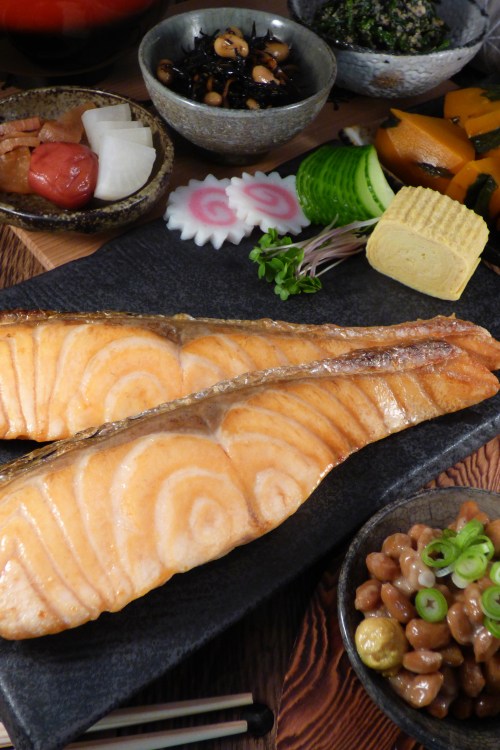
If time allows in the busy schedules of modern city living, one of the most harmonious and revitalizing meals you could possibly enjoy can be found in the traditional Japanese breakfast, or asa teishoku.  Built around the structural concept of ichijusansai, meaning one soup and three dishes, the standard spread for a Japanese breakfast includes miso soup, salted grilled fish, a piece of rolled omelette, and a couple of small vegetable dishes, all accompanied by the ubiquitous bowl of rice and plate of pickles.  Much like a full English breakfast it contains all of the necessary nutrients and calories for a productive morning’s work, but unlike its British cousin doesn’t make you sluggish or weigh you down with unwieldy amounts of meat, and it even contains a large amount of your daily recommended fruit and vegetable intake.

At first glance, a breakfast feast of nine or more components may seem like far too much work to undertake on a day-to-day basis (and in many respects it is- most modern Japanese people now eat a Western-style breakfast of bread or pancakes more often than a traditional spread) but most of the dishes are served either cold or at room temperature so can be made in advance and kept refrigerated until required, with only the soup and rice really needing to be cooked fresh in the morning.  All of the dishes from this typical breakfast also work incredibly well when used in a bento lunch or as side dishes to an evening meal.

wachoshoku
Asa Teishoku- the Japanese way to start the day.

Continue reading “Asa Teishoku”

Gunkan maki

A hand formed pillow of sweet, vinegared sushi rice just the right size for a greedy mouthful or two dainty bites, with a glossy green perimeter wall of toasty seaweed surrounding it, holding back a cascade of glistening, salty, baubles like an overfilled treasure chest bursting at its seams.  A relative newcomer to the world of sushi, gunkan maki- or battleship rolls- were created in the 1940s with one purpose in mind- to hold in the soft, loose ingredients that had been missing from menus for too long.  The tall boundary of nori confines some of the most coveted toppings (but also daunting in the eyes of many westerners): creamy, saline oysters; savoury, pungent nattō; the smooth, delicate roe of sea urchins; and our favourite- tumbling mounds of spherical, translucent, jewel-like fish eggs.

The eggs used for topping gunkan maki vary tremendously from the large red and orange ikura and sujiko roe of the pacific salmon, to the tiny, crunchy tobiko flying fish roe; masago from smelt and ebiko shrimp roes are also popular, with sturgeon caviar even making an appearance from time to time in modern restaurants.  Whichever roe you choose, they all make a delightful morsel, packed with unique flavours and textures unlike those found anywhere else on the sushi menu, and often made even more special by the addition of the yolk from a quails egg, the rich creamy taste smoothing out the briny, ocean notes of the roe and creating a simple, harmonious sauce for the sushi.


gunkanmaki
Gunkan maki- sushi treasure chests overflowing with jewels.


Continue reading “Gunkan maki”

Chirashizushi

The four heavenly creatures in Japanese mythology are: Seiryu the blue-green dragon, Suzaku the vermilion bird, Byakko the white tiger and Genbu the black turtle.  They govern over the four points of the compass, appear as major constellations in the night sky, embody four of the five classical elements and are representatives of the four seasons.  These godly animals are honoured annually with festivals held for each of them throughout Japan, but their presence can also be felt watching over you more subtly during other times of the year, if you know where to look.

One of the most well known events of Spring is Hinamatsuri, or Doll’s day- red fabric-draped platforms appear in houses, shrines and businesses, and atop these pedestals sit ornamental dolls in the form of the Emperor, Empress, ministers, musicians and other courtly attendants.  People celebrate, pray for the health and happiness of girls in their family, drink shirozake, and most popularly, eat bowls of seasoned rice strewn with a confetti of celebratory toppings.  Literally meaning ‘scattered sushi’, chirashizushi -whilst not only being delicious- pays tribute to the four heavenly creatures by means of their respective colours; blue, red, white and black, all of which are present in the toppings: crisp, tangy vinegared renkon for Byakko; savoury, umami packed shreds of nori and mushrooms for Genbu; crunchy, fresh pieces of mangetout for Seiryu; and finally the saline, bursting bubbles of ikura for Suzaku.  Like the dolls of the festival, these toppings perch on a carpet of shredded sweetened omelette, laid over a platform of seasoned su meshi rice, creating a meal perfectly balanced in textures and flavours.

By far one of the simplest sushi dishes to make in the home, chirashizushi doesn’t require any of the precision slicing or delicate wrapping of seaweed commonly associated with the cuisine, yet it makes a fantastic, vibrant dish to bring to the table for celebrations of all kinds.  It also works incredibly well packed as a bento lunch for those special occasions when you won’t be at home, and is perfect for taking to a tranquil spot in the countryside for a leaf or blossom viewing party.

chirashizushi
Chirashizushi- glistening pearls of salmon roe scattered over sushi rice.

Continue reading “Chirashizushi”

Kinako Dacquoise

As was the case across much of the world, sugar didn’t become widely available in Japan until the late 1800s- it was an expensive luxury ingredient exclusively for the kitchens of the wealthy and was used by artisan craftsmen to create elegant desserts and sweets.  Outpriced by the upper classes, the sweet cravings of everyone else were instead satisfied by a uniquely Japanese ingredient; a mellow, toasty, nutty, yellow flour called kinako.  Made from finely ground roasted soy beans, kinako has a delicate sweetness, much more subdued than that of sugar, but more than just sweetness, it imparts a wonderful flavour of its own wherever it is used- a distinctive, warming, caramelly mixture of freshly popped corn and roasted nuts.  Typically used as a powdery topping for sticky rice cakes like daifuku, warabi mochi bracken jellies, or heaped atop a mound of snowy shaved ice, kinako also makes a fantastic flavouring for baked treats like airy chiffon cakes and impossibly light French style cookies.

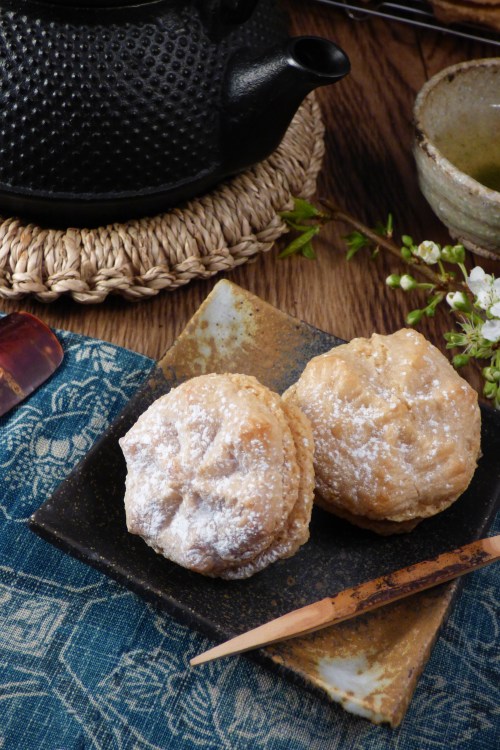
When one thinks of French cookies, macarons are normally the first image that springs to mind- the perfectly round sandwiched confections, with their shiny, smooth outer shell and concealed creamy centre- and, while kinako does make for an exquisitely flavoured macaron, I’d much rather eat this humble powder in a gutsier, less delicate form. That form is in the macaron’s unassuming, rustic country cousin, the dacquoise.  More straightforward to make than a macaron, the dacquoise uses much of the same ingredients and techniques- folding ground almonds and icing sugar into beaten egg whites- but produces a much cakier cookie, with a meltingly chewy centre and a craggy crisp exterior.  The nutty aromatic toasted kinako pairs wonderfully with the almond in the cookie shell, and the brown sugar in the silky buttercream filling heightens the rich, warming, caramel flavours.  Despite their homely appearance, these dacquoise make a fantastic addition to an afternoon tea or packed as part of a picnic for your next blossom viewing party.


kinako-dacquoise
Kinako dacquoise- old school Japanese flavours make the best French confectionery.

Continue reading “Kinako Dacquoise”