Onsen Tamago

Once places of legend and mystery- boiling sulphurous waters forced from deep within the earth, gouts of fiercesome steam and perhaps even home to ghosts and monsters- the onsen or spa towns that are dotted along Japan’s mountain ranges are now prime destinations for people to bathe and absorb the health giving properties of the mineral rich waters.  Tourists flock to towns such as Beppu in Kyushu to take in the eight different ‘Hells’, buy concentrated mineral salts to infuse their own baths at home and to sample local foods cooked in the steam that issues from the hillside.  These geothermally cooked foods are not just a recent invention for tourists however, locals have been utilising the naturally stable and constant temperature of the springs to prepare their food for centuries, the most popular use being for soft poached eggs, or onsen tamago.  After dropping a basket of eggs into the pool of a hot spring, they could be left unattended for an hour or two while the owner went about their other duties (or simply had a relaxing bath) before returning to collect their cooked eggs- rich, soft, custardy yolks, suspended within the silkiest of egg whites, the type of slow cooked eggs that modern restaurant reviewers rave about.

These most delicate of eggs can be made just as well at home and with no need for a volcanic hot spring, slow cooking them for three quarters of an hour at a low temperature is all that’s needed to coax the eggs to lightly set perfection.  Unlike boiled eggs which are forced into springy submission by the fierce heat of the water, onsen tamago are gently persuaded to gel into a mass that can barely hold itself together, collapsing lazily at the slightest touch of a chopstick into a creamy unctuous puddle.  They’re a staple part of a Japanese breakfast, served on top of steaming hot rice or plunged in a pool of broth, but they also make an incredible topping for a bowl of ramen, cracked open over a plate of spicy karē-raisu or dipped into batter and fried as one of the most delectable tempura imaginable.

 

onsen-tamago
Onsen Tamago- slow seduction and a long bath make the silkiest eggs.


Continue reading “Onsen Tamago”

Karē Udon

Finding inventive ways to make use of leftovers is a problem home cooks have no matter what country they’re in, so it should come as no surprise that Japanese cooks have been putting their excess portions of curry to good use for decades, stretching them out as fillings for doughnut like breads or turning them into soups.  Karē udon is a perfect example of this respectful attitude towards “waste” food, by adding leftover pork and vegetable curry to a fishy broth and some thick, chewy noodles you can create a wholesome, warming dish perfect for getting you through these freezing Winter nights.  It might not seem like the obvious choice to use a dashi based stock for this soup, but it creates a wonderfully rounded savoury flavour rather than anything particularly fishy tasting.  This combination of dashi, sake, mirin and soy sauce as a soup stock is known as mentsuyu, and is the classic starting point for many udon and soba dishes, even being used as a refreshing dipping sauce for cold noodles.

Karē udon, perhaps one of the country’s most popular comfort foods, has the same effect on the Japanese as a plate of macaroni and cheese might on an American or a bowl of hotpot on a Lancastrian.  It has the incredible power of evoking nostalgic memories of childhood, relieving emotional stress and giving a feeling of the security of being at home, somewhere you belong.  Not bad for a bowl of soup.

curry udon
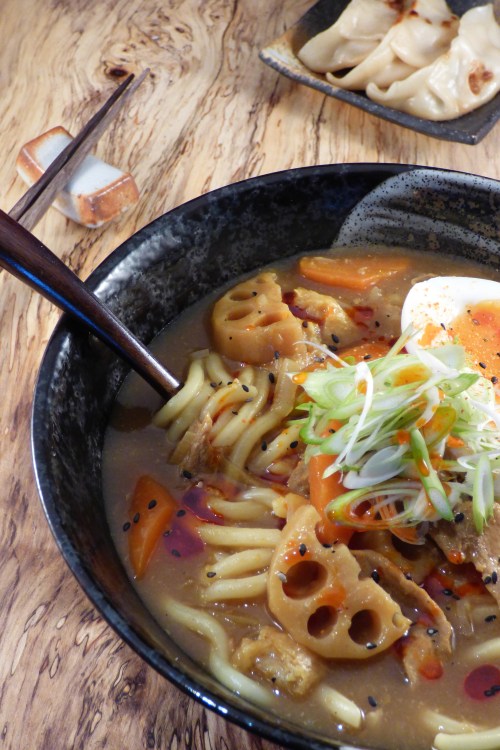
Kare udon, why choose between curry and noodle soup when you can have both?

Continue reading “Karē Udon”

Karē raisu

Although it is only a relative newcomer to the cuisine of Japan, curry and rice can be bought in any town across the country from a huge range of restaurant chains.  Karē is based upon a British Raj style curry, so has more in common with Victorian English cookery than it does true Indian cuisine, and although traditional Northern Indian style curries have recently found their way into Japan’s diet, Japanese karē remains one of the country’s most popular dishes.

Instant karē sauces are readily available from convenience stores and supermarkets in roux form, and they’re all delicious, but we’ve chosen to make our own from scratch.  Straying slightly from the path of tradition we’ve gone for a chunkier version of karē with more vegetables and meat, but we still have the smooth, silky, sweet sauce that everyone loves.  If you leave out the vegetables and meat from our recipe you’ll have an excellent sauce for katsu-karē or a base for curry udon soup.

kare
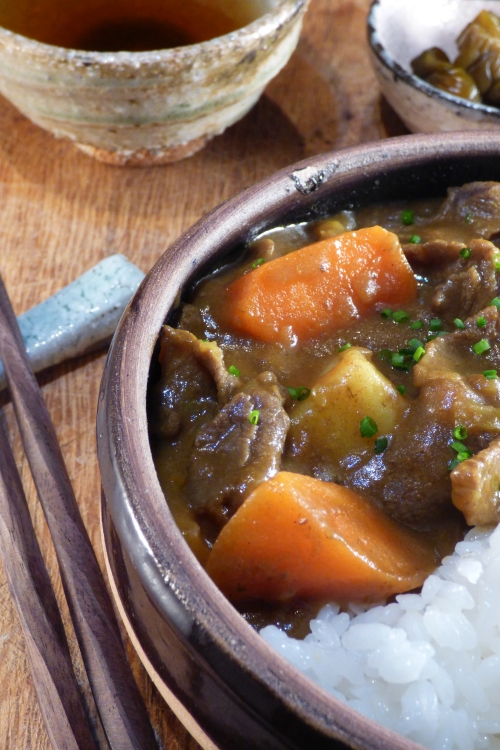
Kare raisu; sweet, rich curry sauce with beef, potato, kabocha and carrot.


Continue reading “Karē raisu”