Shoyu tamago & Hakusai no shiozuke

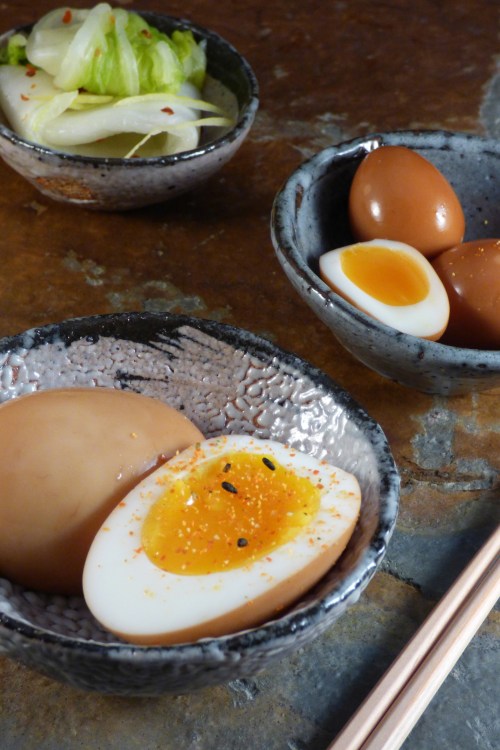
Boiled eggs feature in many dishes like oden and ramen, and they make a great snack or addition to a bento.  Most often they are cooked until the yolks are solid, however we like ours to be barely set, especially with tiny quail eggs which you pop in your mouth whole and burst to release the rich gooey centre.  By lightly pickling them in a sweet and sour soy liquor you can add a level of complexity to their whites and stain them an attractive glossy brown colour too.  Shoyu tamago are a great replacement for use in any recipe which calls for boiled eggs, and their natural saltiness makes them a perfect accompaniment to drinks.

Hakusai no shiozuke is on the other end of the flavour spectrum, rather than being rich and gooey like the shoyu tamago it is crisp, spicy and fresh with lemon zest.  Chinese cabbage is pressed and pickled for a short amount of time to provide a punchy accompaniment to meals and a perfect counterpoint to rich or fatty meats.  This traditional recipe is a delicious introduction to salted pickles for those who’re a little wary of the tsukemono plate that comes with most Japanese meals.
soy eggs
Pickles are great for adding interest to a meal

Continue reading “Shoyu tamago & Hakusai no shiozuke”

Supuratto no kanroni / Iwashi no kanroni

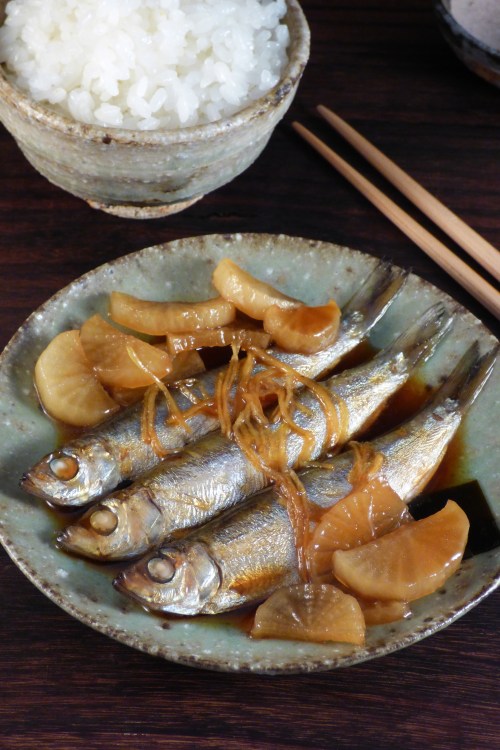
Being an island nation, Japan has always consumed a huge quantity of seafood, and up until recently this has also been true of the British Isles, a tradition that we’re sadly losing.  Whilst shopping in our local fish market we came across some beautifully fresh sprats, a very typical fish in classic British cuisine and knew we could use them to make something very Japanese.  Sprats, as with most small fish, have fallen out of favour in recent years as people tend to prefer larger fish with fewer bones, however they’re packed full of omega oils and B-vitamins and their flavour is well worth the little extra effort.  As sprats are from the same family, these little oily fish are a perfect substitute for the sardines that would normally be used in this old fashioned dish of daikon, ginger, fish and a sweet sticky sauce.

An old Japanese trick to cook oily fish with sake to lessen the strong odours is used in this recipe, and the spicy shards of ginger cut through the richness.  If you can’t get hold of sprats then use sardines and allow 2-3 fish per person for a main course.

Kanroni
Supuratto no kanroni: Little fish, big flavours.

Continue reading “Supuratto no kanroni / Iwashi no kanroni”

Mekabetsu shiraae

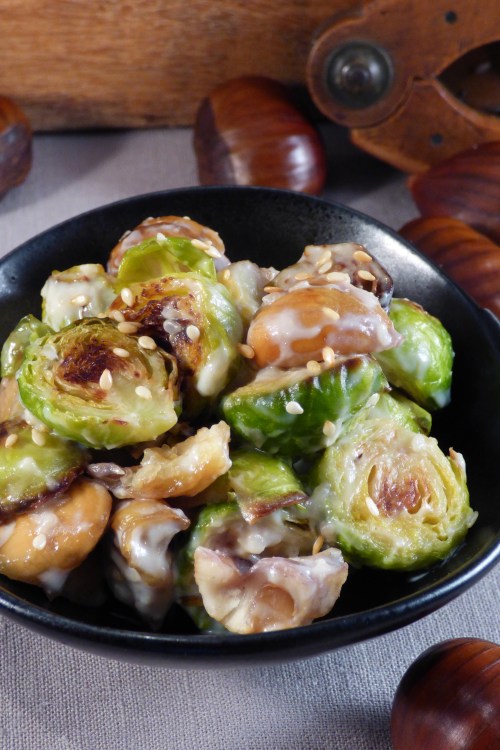
With Christmas being a week away today, the time is just right for cooking up something using some festive ingredients, namely the much maligned Brussels sprout and that street vendor classic, roast chestnuts.  Sprouts aren’t that common in Japanese cuisine, but being from the cabbage family they fit into the flavour palate beautifully, and when paired with a classic shiraae dressing and the rich flavour of chestnuts they make a fantastic aemono dish.

Aemono translates roughly as ‘harmonised food’, and refers to dressed vegetable dishes, rather like cooked salads, eaten as accompaniments to main meals.  The different dressings used in aemono range from mustard or vinegar to miso and sesame paste; we’re pairing our vegetables with a shiraae dressing based on tofu and white miso, to give a smooth, cool, creamy side.

shiraae
Shiraae sprouts with chestnuts, a perfect accompaniment to your Christmas bird.

Continue reading “Mekabetsu shiraae”

Daigaku imo

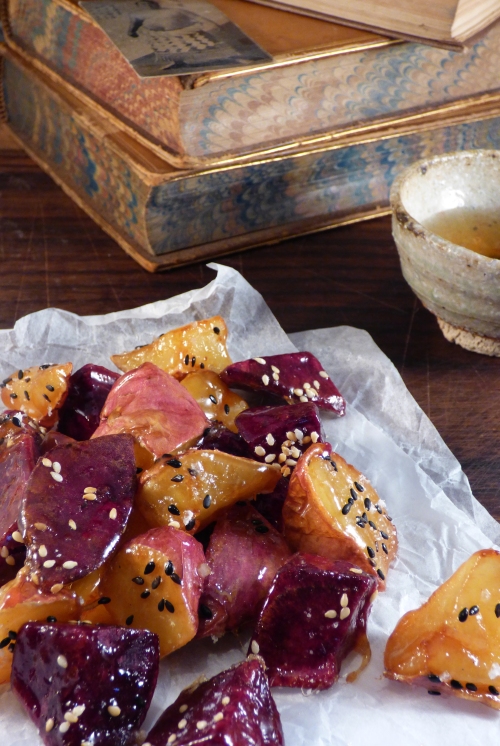
The rather cryptically named daigaku imo, or university potatoes, have been a staple snack food across the university towns of Japan since the 1920s.  Deep fried sweet potatoes, tossed in caramel flavoured with soy sauce which quickly becomes brittle in the air; what’s not to love about them?  The soy caramel coating brings to mind the salted caramel chocolates which have become popular in the UK over the last decade, and the glazed potatoes make me think of American Thanksgiving style candied yams.  Traditionally these are made with the red-pink skinned, white fleshed sweet potatoes most common in Japan, but we ate some made with the gloriously bright purple murasaki imo in Kamakura and couldn’t resist recreating those in part here.  Murasaki imo have an almost winey, lychee flavour to them which works wonderfully with the salty soy sauce.

daigaku imo
Daigaku imo; fried sweet potatoes, glazed in soy caramel and sprinkled with gomashio.

Continue reading “Daigaku imo”

Two side dishes- Tataki Kyuri & Chikuwa to negi no sarada

One of the most enjoyable things about a Japanese meal is the sheer number of plates and bowls you get, little plates of pickles, bowls of dipping sauce, salads and small vegetable sides.  In a restaurant you can think you’re ordering one basic dish and then end up with seven or eight little portions on your table per person.  In this post we’ve got recipes for two such dishes; a punchy, strong pickled cucumber, powerfully seasoned with raw garlic, and a fresh salad of chikuwa fishcake mixed with spring onions and red peppers, topped with dried bonito shavings.


chikuwa
Smashed cucumber pickled with garlic & Chikuwa salad with spring onion.

Continue reading “Two side dishes- Tataki Kyuri & Chikuwa to negi no sarada”

Cooking Japanese rice

Rice is the most important component in nearly every Japanese meal so cooking it correctly is a good skill to master if you want to regularly eat Japanese food.  When we first read about cooking rice the Japanese way, we were put off by the washing stages, thinking that they couldn’t possibly make a difference to the finished product- how wrong we were!  If you don’t wash your rice well, or even if you wash it half-heartedly, you end up with an overly starchy mass which lacks the flavour, character and definition of properly cooked rice.  In our opinion the best rice to use is Koshihikari (Megumi is an excellent brand), it has very short grains which retain a distinct bite, a beautiful pearly appearance, and a sweet flavour unrivalled by other rices.  There have been many times while eating a bowl of this rice that I have thought to myself, I could be happy eating nothing else but perfectly cooked plain white rice for three meals a day.

In Japan, nearly all rice is prepared in electric rice cookers, and while we couldn’t justify the storage space for a dedicated rice cooker, we have perfected a way to cook it in an Instant Pot electric pressure cooker that gives identical results. Don’t worry if you haven’t got an Instant Pot, we’ve included instructions for cooking rice in a saucepan too.

rice
The cornerstone of nearly all Japanese meals.


Continue reading “Cooking Japanese rice”

Two ways with kabocha (kabocha namul & kabocha no miso)

With Autumn being our favourite time of year it only stands to reason that kabocha squash, being such an Autumnal vegetable, is one of our go-to ingredients when we want to eat something Japanese and comforting.  Kabocha, with its sweet yet savoury flavour makes a great main component for a meal, but works just as well as a side dish or a splash of colour in a bento.  These recipes work well with butternut squash or most other hard skinned winter squashes (crown prince is a really good match for kabocha in both flavour and texture, but it’s probably best to peel its harder outer skin away)


Kabocha Namul.

Namul (or namuru) is a family of dishes of Korean origin; shredded vegetables, seasoned with sesame and served as a side dish.  This namul works really well as a side dish to rich, sweet meat dishes such as buta no kakuni, and its nutty flavour contrasts extremely well with vinegared foods or those served with a ponzu dipping sauce.  It even makes a great coleslaw substitute in sandwiches.

kabocha namul
Kabocha Namul, delicious served with Buta no Kakuni.

Continue reading “Two ways with kabocha (kabocha namul & kabocha no miso)”