Teuchi Udon

Grain milling technology is said to have entered Japan during the thirteenth century when a Buddhist monk, Enni Ben’en, returned with it after studying meditation in China.  Along with that mechanical knowledge, he brought with him the idea that would eventually lead to the thick, white, toothsome, wheat flour noodle that we know today as udon.  Easily our favourite type of noodle, udon has enough character to be the main focal point of a dish, whether it’s a meal of chilled noodles with dipping sauce in the heat of the Summer, a plate of fried yaki-udon bought from a yatai at a festival or sunken deep in a bowl of smoky pork broth, topped with slow braised meat and a boiled egg.  There are some fantastic udon available to buy from supermarkets, even here in the UK, and they’re the ones we use day-to-day, but when we want something that little bit special, when you want the noodle to break free from its supporting role and be the star of the dish, nothing beats making them yourself.

Making noodles at home is a simple affair, requiring very few ingredients and not taking much time at all; kneading the dough is perhaps the only labour-intensive part of the process and that is made a lot easier by letting your feet do the work rather than wearing out your arm muscles.  The beauty of making udon yourself rather than buying them really lies in the ability to make them whatever size and shape you like- from the almost paper thin Himokawa noodles of Gunma Prefecture, to the finger-thick “Two Noodle” udon of Kyoto’s Tawaraya restaurant and everything inbetween.  Our preference lies somewhere towards the Ise udon end of the spectrum- larger and thicker than commercially available noodles, but not so fat that they take a whole hour to boil them.


udon
Homemade udon noodles, served bukkake style.

Continue reading “Teuchi Udon”

Kitsune Udon

We’ve been visiting noodle restaurants for almost as long as I can remember, and have passed over a basic sounding dish on the menu many times, dismissing its simplicity in favour of the more showy, topping laden bowls.  That is at least, until a couple of years ago whilst on a lunchtime visit to a market in Kyoto, we stopped by an udonya and tried the curiously named Kitsune Udon (fox noodles) for the first time and became instant converts.  A deep bowl of perfectly cooked, thick white udon, a slightly smokey, fish based soup, and a single piece of inari-age, simmered in a sweet soy and mirin liquor until the sponge-like tofu had absorbed a massive amount of flavour.  The clean soup paired with the rich, sweetness of the tofu was an incredibly soothing combination, and one that we’ve tried to eat as often as possible since our first taste.

Many people like to add narutomaki or kamoboko to their kitsune udon -and feel free to if you want, they’re both delicious additions- but we like to keep ours uncomplicated and the way we’ve always eaten it in Japan; just the noodles, the broth, a sweet slab of toothsome inari-age and a mound of spicy, fresh spring onions.  Perfect comfort food if you’re feeling a little under the weather and great fuel for foxes on a night-time prowl.

kitsune udon
Kitsune Udon- a soothing bowl of soup topped with seasoned abura-age, the favoured food of Japanese foxes.

Continue reading “Kitsune Udon”

Karē Udon

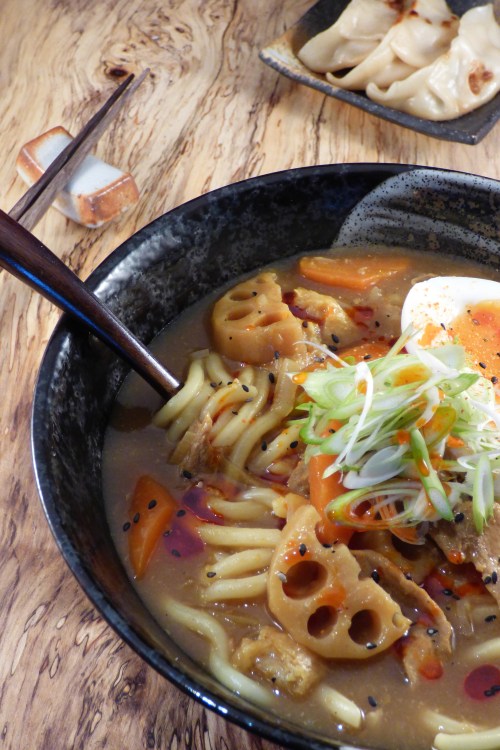
Finding inventive ways to make use of leftovers is a problem home cooks have no matter what country they’re in, so it should come as no surprise that Japanese cooks have been putting their excess portions of curry to good use for decades, stretching them out as fillings for doughnut like breads or turning them into soups.  Karē udon is a perfect example of this respectful attitude towards “waste” food, by adding leftover pork and vegetable curry to a fishy broth and some thick, chewy noodles you can create a wholesome, warming dish perfect for getting you through these freezing Winter nights.  It might not seem like the obvious choice to use a dashi based stock for this soup, but it creates a wonderfully rounded savoury flavour rather than anything particularly fishy tasting.  This combination of dashi, sake, mirin and soy sauce as a soup stock is known as mentsuyu, and is the classic starting point for many udon and soba dishes, even being used as a refreshing dipping sauce for cold noodles.

Karē udon, perhaps one of the country’s most popular comfort foods, has the same effect on the Japanese as a plate of macaroni and cheese might on an American or a bowl of hotpot on a Lancastrian.  It has the incredible power of evoking nostalgic memories of childhood, relieving emotional stress and giving a feeling of the security of being at home, somewhere you belong.  Not bad for a bowl of soup.

curry udon
Kare udon, why choose between curry and noodle soup when you can have both?

Continue reading “Karē Udon”